It's all the rage.
Showing posts with label How to. Show all posts
Showing posts with label How to. Show all posts
08 October, 2010
19 July, 2010
How to make Waffle Cones and Ice Cream in Michigan
Vacation time in Michigan. The original DIYer, my mom, makes makes waffle cones and chocolate chip ice cream. Look for cameos by U-Pick blueberries, U-pick apricots, and gram-gram as the plonger.

30 June, 2010
18 June, 2010
03 June, 2010
09 September, 2008
Belly Time
Have you been thinking about making bacon? Now is the perfect time; with the hint of fall in the air, the gentle wisps of hickory smoke should trigger tingling childhood memories like skipping stones on Lake Hope. The late tomatoes are now ripe on the vine. Make up some bread, some mayonnaise, and assemble BLT's. Serve the sandwiches with smoked corn chowder and now you are ready for the season. Maybe a nap first.
Before any napping there's work to be done. The hardest part of making bacon is finding the belly. Ok, if you live in town nick-named "Hog Butcher to the World," maybe it's not that hard. I get bellies at a meat packer about three miles from my house (say YEAH Southland), the problem is usually the ones in the case are pretty thin, they keep the nice ones in the back to make their own cured love. My friend Brian in New Jersey gets them from a Chinese market with the ribs attached. When searching for your own try to find a place where you can choose your piece, if you don't see one you like, ask if there are any others. Make sure you get a thick belly. If you are at a meat packing operation you'll have to buy a whole belly, they wont cut it, and you're gonna get 12 to 19 pounds of pork. But that's what you want. Get the biggest, thickest belly you can find, because we are not just making bacon, we are stocking the larder.
When you get you purchase home you may find one end is really thick with very little fat, and the other end thin and nothing but fat. In addition, an untrimmed pork belly with have fat and meat (a flap of sorts) that sits on top of our future bacon. Now you can simply cut it up into to manageable pieces a cure it, but why not make it look nice?
With my pork side I used the thick, lean portion of the belly and removed the lean flap to make couple of pounds of our house sausage. I used the fatty thin end and any trimmed fat to make lard. I also saved the skin from each of these sections and threw it in the freezer. Skin is useful to thicken soups, Cassoulet, or boiled and diced for a pâté.
I squared up the future bacon and rubbed it with a mixture of sugar, salt and curing salt. Curing salt is a special order item, I get mine at The Spice House in Chicago. I used the recipe from Charcuterie by Michael Ruhlman and Brian Polcyn, for the dry rub. On a smaller piece I poured on a little maple syrup in addition to the dry rub. The pieces go into ziploc bags and cure in the fridge for five days. In the past I have cured bacon in brine along with ham. I haven't noticed any big difference between the wet and dry cure, except that the wet cure only needs three days.
After the cure was complete, I rinsed off the bacon and let it rest in the fridge of 24 hours uncovered. I actually let it go for two days because I got busy with other stuff but the pork didn't mind.
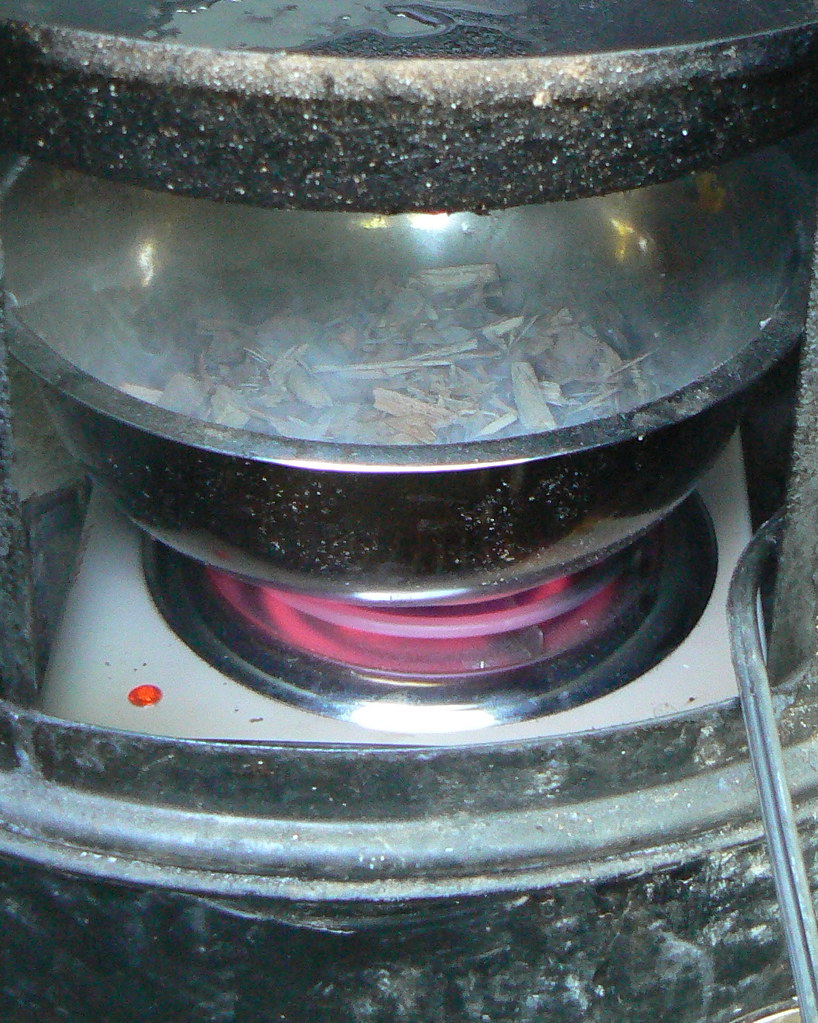
I cold smoked both pieces of the belly for about four hours. The cold smoke rig consisted of a hot plate and stainless steel bowl inside my Bullet. The next day I hot smoked the larger slab for about two hours. While I had the smoker fired up I also threw on some eggplant (smoked baba ganouj) and I hot smoked a few ears of corn (shucked) for the smoky corn chowder. Bonne Femme made the soup.
Cold and hot smoked bacon
Cold smoked bacon
Either way its a winner.
My mom was here last week and she started her own bacon. She took it back to Columbus and she will smoke it on her kettle grill.
Bacon: A pantry staple that's fun for the whole family.
Cheers.


14 November, 2007
MAC's Holiday Turkey Tips

So you're bootin around the web looking for Turkey Tips? Well you found the right place. I am not going to give some fancy pants preparation, just straight talk so that you can keep cool during a time when it feels like all heck is about to break loose.
1. Plan ahead.
The name of the game is preparation, play it right and the only thing you'll have to do on T-day is drink a beer and watch the smoke curl off the barbecue (okay maybe there's a few things to do). Start out by getting a Turkey. What you don't have one yet? Go now go go go. Most turkeys you'll find at the store are going to be frozen and they take several days to thaw. 24 hours for every 4-5 pounds of meat, says this month's Gourmet magazine. Placing an order for a bird (about a month ahead, too late now) is always a good idea, supermarkets usually provide this service and you can request that they thaw it for you. In the past, I have ordered Kosher turkeys which can save you some prep time (I'll talk about that in a moment). You can also snoop around to find locally produced turkeys. For second year in a row, we ordered our turkey from the Dickmans. They have a farm down by Kankakee were they pasture raise poultry.
2. Selection.
Think small. Don't worry about leftovers, pick the smallest bird that will feed your crew. We cooked an 11 pound turkey recently that fed 6 adults and 2 children and still had half a bird left. I think you should be able to serve 8-10 with a 12 pounder. A smaller size is easier to handle, and cooks quicker. Maybe right now you are thinking, jeeze that's small, I don't wanna run out of meat; I get the same feeling every time ("It's not enough food!"), relax, let's chant together: Pick the small guy, pick the small guy. It works.

3. Cure yer bird.
You don't need fancy pants seasonings, you don't need a flavor injector, I don't have a turkey baster, I don't own a basting brush. Here's my secret ingredient: Salt. A brine cure changes the flavor of the meat in magical ways. It's juicer too. Both Best Recipe by Cook's Illustrated and Charcuterie by Michael Ruhlman have good discussions on brining, but here is what I did: Dissolve 225 grams (1 cup) of Kosher salt per 4 liters ( 1 gallon) of water, make enough to cover the turkey. I used maybe 8 liters for my 11 pound pullet, make sure you use a non-reactive container: Stainless steel, glass or plastic. Put a weight on it to submerge. Let it soak in the fridge for 18 hours. Be careful on the time, leave it too long and it can get too salty. Some brine recipes call for sugar, it doesn't do much for me and I think it causes the skin to brown (read blacken) quicker. You don't have a bucket that big? Here are two alternatives: Order a Kosher turkey, they are already salted, most supermarkets can get you one. Do a salt rub, the November 2006 of Cook's Illustrated from has a salt rub recipe, I never tried it, but Novak did and he was happy with the results.
3. Give it a rest.
After the briny soak let your tom dry in the fridge uncovered for 12 hours. This will give the brine in the bird time to balance and the skin a better chance for crisping during cooking. Before resting, truss the turkey. Towards the end of the 12 hours brush the skin with some olive oil.

4. Let's take it outside.
Nothing finer than smoked turkey, my weapon of choice is the Weber Smokey Mountain, but you can use a kettle grill, gas, whatever. The important thing is to create indirect heat and a hood temp of 350F. You skoff? yeah I said 350, I wanna have my turkey sometime today and the skin will be crispy and it will have plenty of smoky flavor. Before putting it on, brush it again with some olive oil, if you have a thermometer that you can leave in while cooking, stick that in, and start cooking. Plan for three hours, check it every once in a while, make sure one side isn't cooking faster than the other, but try not to peek too often. When the internal temp reads 165F pull it off and let it rest. If you can't do it outside, cook it in a 350F oven, maybe stick some fresh herbs in the cavity like rosemary, thyme, parsley, bay leaf and some peeled cloves of garlic. I haven't cooked a turkey in an oven in a long time, but that sounds good.

5. Carving.
Unless it is chiseled in stone on the dining room wall, don't carve the turkey at the table, put the whole bird on a platter, present it to your guests, then take it back to the kitchen for the wet work. Pick out a long, thin, sharp knife and cut up one side at a time. Remove the leg and thigh together at the thigh joint then find the then remove the wing at the joint. Now the easy part: Remove the whole breast from the side you are working on. Start by making a longitudinal cut along the breast bone then work the knife along the ribs so that you have one big boneless piece of meat. Now can cut straight across the boneless breast for 3/4 inch thick slices. I think the pros call em cutlets. Cut up the thight meat serve the drum whole. Serve the turkey warm, enjoy the company.
To Review: Get it, thaw it, cure it, dry it, cook it, cut it, serve it. What could be easier?

Here is a sample thanksgiving menu:
Brine cured smoked turkey
Cornbread mushroom stuffing
Mashed potatoes with roasted parsnips
Sauteed Swiss Chard with garlic and red pepper flakes
Giblet gravy
Cranberry sauce
Pumpkin Pie
Please don't make yourself crazy with the holiday, good food is important but taking time to be with friends and family is what really matters. if the turkey burns, make spaghetti.
Cheers.
17 August, 2006
Columbus….Oh. – Chicken Sausage and Peach Sangria Recipe

"Fairest of months! Ripe summer's Queen,
The hey-day of the year,
With robes that gleam with sunny sheen,
Sweet August doth appear."
At least that is what it says on one of my mom's placemats. I believe those lines should be attributed to Gillian Douglas, but a Google search did not turn up much on her, maybe because she's Canadian.
But August is the fairest of months, the sweetest of summer, we start to get some cool nights, the garden is mature, tomatoes and peppers must be picked. It is also my favorite time to visit the family homestead in Columbus.
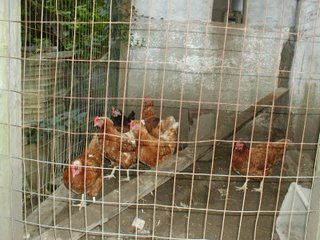 Hello girls.
JL hitched in for a short visit too. She is off to Ethiopia next week and has promised dispatches from the New Flower (Addis Ababa) for our humble blog. She'll be there for a year. To send her off in a proper fashion I figured to make some sausage. JL said she hadn't had a decent chicken sausage and wondered if we were up to the challenge.
We went to Weiland's Market for supplies. Weiland's has been in the Clintonville area forever and it has always been the place to go for meat. About six years ago they vastly expanded when they took over a space that used to be an A&P (Yeah, I remember when it was an A&P, and Volunteers of America was a Buckeye Mart). Now they offer an extensive selection of gourmet stuff, perfect for the summertime party. We picked 3 ½ pounds of chicken thighs, some pork fat (trimmed on the spot and free), a few Ohio peaches and bottle of Piesporter Michelsberg.
Making sausage is relatively easy, but there are some details to follow and I recommend you read about it. Some good books are: Charcuterie: The Craft of Salting, Smoking and Curing, Bruce Aidells' Complete Sausage Book , or Cooking by Hand. You should be able to get any of these books at the library. As for equipment, you need a grinder and a stuffer. Provided you have a Kitchen-Aid Stand Mixer, the easiest and cheapest way to get grinding and stuffing is with a grinder and stuffing attachment. The Charcuterie book offers specific instructions using this equipment.
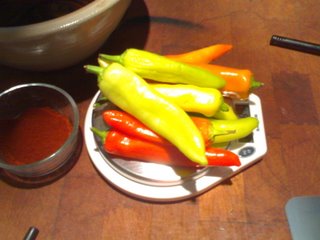
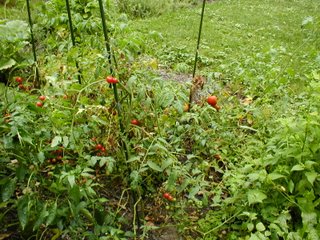
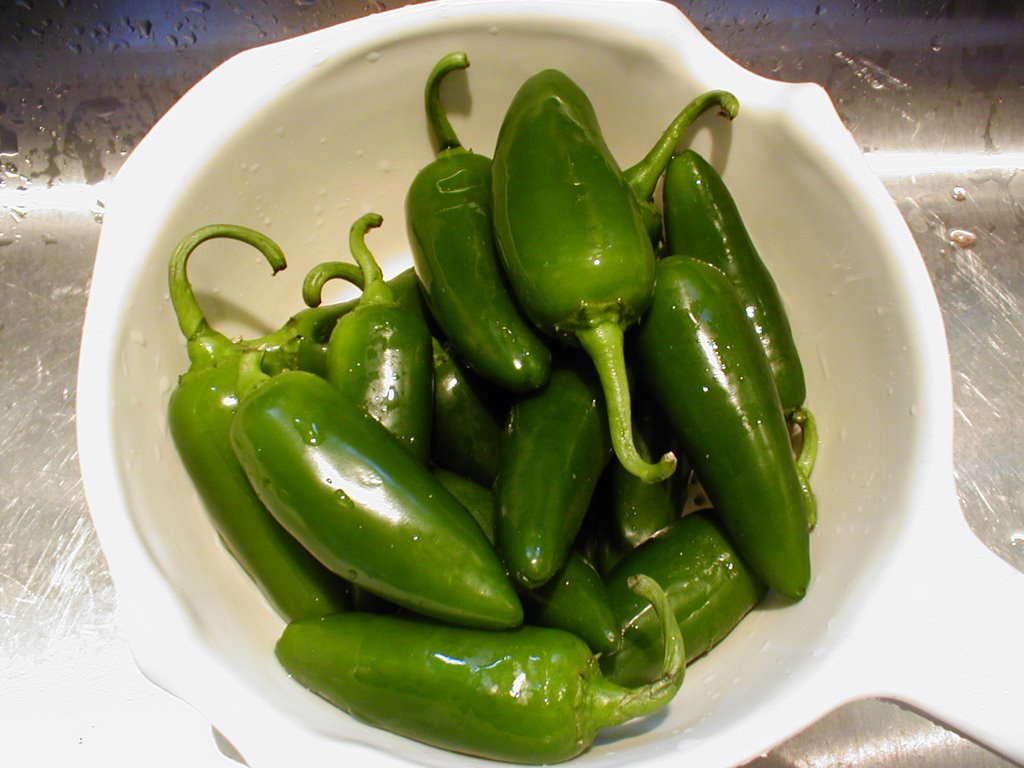
I don't know what kind of peppers these are, but the red ones are kind of hot.
Now for the sausage. We got some mystery peppers out of the garden (I say mystery because we only bought poblanos jalapenos and sweet reds and these look like none of the above), roasted, cored, seeded and chopped them up for the mix. I diced the Chicken and the fat and tossed them with some cornstarch. The cornstarch idea comes from stir-fry; a cornstarch dusted meat retains its water, I dunno it works in the Phad Thai, see if it works here. Then I mixed in the toasted spices, and some garlic and a let it sit for a hour.
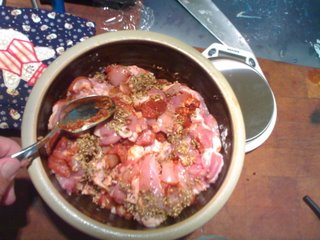
Let it sit longer if you have the time. I put the mixture in the freezer for ½ hour before grinding. Then I ground it into a bowl sitting in an ice bath.
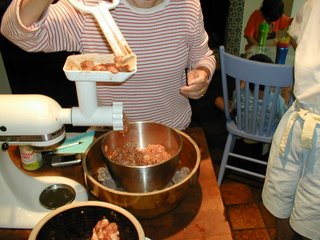
You gotta keep the sausage cold or the texture will be bad. After grinding, I mixed the sausage with the paddle attachment for about a minute adding the vinegar.
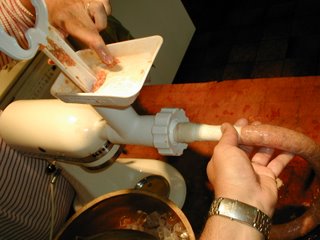
Mom helped with the stuffing.
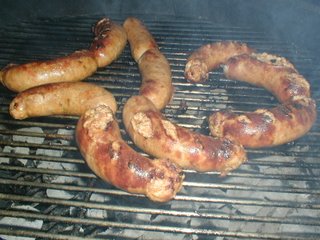
Time for the grill. As you can see here our little sausages are bursting at the seems. JL asked why we didn't boil them first. I gave her a long winded answer that wasn't entirely accurate but after a little reading here's what I should have said: Boiling (more accurately poaching in a water bath 180-200F, which I did say) is a good way to get a sausage up to temperature. It's gentle and accurate. Cook a sausage to 160F (maybe a little higher for chicken), beyond that cooking just dries it out. However poaching imparts little flavor; Grilling has the best flavor. The problem with grilling is controlling the heat. If a sausage cooks too fast it may burst and get over cooked. Grill over medium heat. Our fire here was a little hot.

Time for dinner. Some tomatoes from the garden chopped up with some fresh mozzarella, corn pudding from grandma, and to drink peach sangria. With peaches in season what could be better.
The sausages turned out very nice. Usually a chicken sausage has dry and flat taste, but I think the added fat and the roasted peppers brought the meat around for a full flavor and plenty of moisture. I don't know if the cornstarch helped with the moisture issue, I'll try it sometime without it. The ingredient list follows.

JL adapted the peach sangria recipe from Bon Appetit, August 2003. 1 bottle of white wine, 750 ML of white cranberry Juice, ½ cup peach schnapps, 4 peaches peeled and sliced and 1 lemon sliced.
Italian Chicken Sausage with roasted peppers.
3-1/2 lbs Boneless skinless chicken thighs
¾ lb Pork fat
8 oz (weight before cooking) Mild peppers (Anaheim)
2 Cloves garlic, peeled minced
30 g Kosher flake salt
20 g Paprika
16 g Whole fennel seed, toasted
8 g whole coriander seed, toasted
2 T Cornstarch
175 ml Cider Vinegar
Cheers
02 August, 2006
The Mail Bag - Slow Pork Taco Recipe

[Dear SMAC,]
Ha! I did find a 3# pork shoulder chunk at the ShopRite on Monday. I'd like to do a rub/marinade and grill it the next day for tacos. No achiote seeds on hand but I have everything from Bittman's carnitas recipe in the Times last week. Any suggestions on the marinade? Should I try to add some wood for smoke when I grill it? What temp am I shooting for internally? Do I need to add something to make steam when I grill it?
Signed
sweatin' and grillin'
West Orange, NJ
Dear SWAG:
There’s always a wise guy out there tryin’ to break yer shoes. I’m sure you could find a three pound piece of shoulder in the crammed, family of six studio apartment dwelling, environs of NYC; there is only so much you can fit into one of those Holly Hobby Easy Bake Ovens. But all jabbin aside, how about that heat? Do not try to make sausage in this kind of weather it’s just too hot, but my order of Fermento and Dextrose showed up today so we are going to get down to business soon.
Now about grilling three pounds of pork shoulder. First about the Bittman article, seriously, it looks like page 298 of Rick Bayless Mexico, One Plate at a Time except no achiote or banana leaves. Go to the library and check it out.
But anyway, following the carnitas recipe I suggest the following changes:
For the marinade I would replace the lemon juice with fresh squeezed lime juice and bump it up to at least ¼ cup up to ½ cup. Bump up the salt too, A heavy tablespoon. I not sure about the authenticity of coriander, it is good for Italian sausage but tacos? Skip that , Instead put in some cloves, less than ½ teaspoon. Double the cumin and double the peppercorns. Put some cayenne in too. After toasting toastable spices (toast only whole spices), grind that all up as powdery as possible. Take your powder your garlic and your juice, and blender until smooth. Put the meat a Ziploc pour in the marinade, message well, and let it go overnight in the fridge.
Now for cooking. Since I know SWAG has a kettle grill (Weber 22”), that will be our weapon of choice. It is actually a perfectly good tool for smoking, especially with such a small piece of meat. First let’s set up the grill: Get some aluminum foil. You are going to build a small charcoal pile (I dunno 15-20 briquettes) on one side of the kettle. Build a wall of foil to sequester the pile with a little room to add more charcoal. Now the foil is not as much a retaining wall, but a heat shield, and a reminder to keep the fire small. Now you can buy some Charcoal Briquet Holders for that fancy pants look, but foil will work just fine. Try to line the rest of the charcoal grate with foil or use a drip pan because it is going to get messy. Fire up about ½ chimney of coals throw that on top of your little pile coals, a couple small chunks of wood (Hickory, I know you have some, I try to avoid bark) and see if you can get your fire to stabilize between 250 and 300F. How do you know when your grill is at temp? Go get a thermometer. For my mom’s kettle I picked up a Weber Grill Food Thermometer and ran it through a cork and stuck it in the vent as pictured here. If I want to control venting, I use balled up pieces of foil.
Arrange the cooking grate so that the handle is over the fire; there will be enough room to feed the fire without removing the grate. Or again, for that fancy pants look, you can get a hinged cooking grate ( I got one of those for my mom too). When cooking like this, I do like to put a pie tin of water over the fire for a little steam. I haven’t done any research and since the meat (a particularly fatty cut anyway) has been marinating, I don’t know how much difference the steam makes, probably not much. I figure it is not too much trouble( make sure it is a pie tin the old lady doesn’t care about, sorry mom), and the water helps regulate the temperature, so what the heck.
It is going to be around 3 hours to get 3 lbs of shoulder “Fork Tender.” What Internal temp is fork tender? 200F. Just cook it as long as you can stand it and look for it to be done anywhere between 190 and 200F. Now I am not positive about this smaller cut of meat, but you may find it races to 160F, then plateaus, and crawls the rest of the way to 200F. Try to keep the temp constant, and throw on another chunk of wood if it isn’t smoking.
Mac’s Modified Slow Roast Pork for Taco Recipe Ingredient List
10 cloves garlic, peeled
3 pounds pork shoulder, preferably boneless and in one piece (whatever)
1 Tablespoon peppercorns
1 teaspoon (or more) dried Mexican oregano (or Greek, don’t bother with fresh unless it is in your garden, which it should be)
1 Tablespoon cumin seeds
1 teaspoon cinnamon powder
½ teaspoon whole clove
½ teaspoon cayenne
1 Tablespoon salt
2 Tablespoons fresh orange juice
¼ to ½ cup fresh lime juice.
Now I just made this up. I haven’t tested it, tune it to whatever makes sense to you, but it sounds good to me. And do the pickled onions, they are really good. Bayless' onion recipe calls for 3 red onions sliced, 1 1/3 cups lime juice, 2/3 cup orange juice. Marinate overnight. With a three pound roast, you could cut that recipe in half. And add some sugar. For pictures of an 8 pound roast marinating and the pickled onions, see the South Side Tacos post.
Thanks for the question, keep em coming, and SWAG, send us some pictures of your baby roast!
Cheers.
26 July, 2006
South Side Tacos
Well it’s been a busy summer here in the Southland, swimming lessons, traveling, trying not to listen to the news, it’s a wonder for when a guy can get any cooking done. By the way, the South Side was mentioned in the Sunday New York Times, last weekend. In an profile of John C. Reilly, the article stated that Reilly grew up in a “gritty South Side neighborhood…” in a “squat bungalow.” Once again the myth is perpetuated: Say you are from the South Side and folks start lookin to see if you have a gun stuck in your waistband. There must be some rule where folks from outside the Chicago are required to say “gritty” when saying the words “South Side.” I am sure that if, as the article states, Mr. Reilly’s father owned a commercial laundry service, and they lived in a bungalow near Marquette Park, Reilly’s youth may have been more accurately characterized as a “modest middleclass upbringing.” But that doesn’t sound very cool.
Continuing on this digressive diatribe regarding the Times (wait, you’ll see it comes full circle) I read over two articles today regarding Tacos. I’ll insert links for the articles, but I don’t know how long they will work, at a certain point the Times makes you pay to peak. The first article, The Taco Joint in Your Kitchen, by Mark Bittman, has only one valid worthwhile statement: In New York, a good taco is hard to find. True. When I lived in New York, good Latino (Mexican) food was very hard to find, we would travel to the ends of the Earth (New Jersey) in the hopes of finding something above mediocre.
But then the article goes on to state that Genuine Tacos can only be found in the Southwest or Mexico. False. Once again New Yorkeritis rears its ugly head; that’s the disease were the New Yorker (the inhabitant, not the magazine) believes that the only thing West of NYC is New Jersey and California. When I lived there I had it too. Chicago has some of the most beautiful, most delicious, most hardcore Mexican food to be had anywhere, and I missed it terribly when I lived out East. And what goes into a “Genuine Taco” in the little 3 inch corn tortillas supposedly only available in Cali and South of the Border? In my experience, meat. If you ask, and you can put up with the cook shaking his head, cheese. You get three on a plate surrounded by a little lettuce and tomato, and you eat them with a little salsa. Wash it down with a little horchata (no beer, its lunch time, and you are on the job) or if you are at Irazu on Milwaukee Ave., a Guayaba en Leche and there you go, genuine.
The second Article (just a related recipe) Recipe: Slow-Roasted Pork for Tacos, must be geared towards the apartment dweller in Murray Hill. The recipe calls for two pounds of pork shoulder; good luck finding that. Most shoulder roasts come packaged between five and eight pounds and rarely come boneless. And you should cook a full roast at a time anyway, pulled pork freezes really well and reconstitutes nicely in a skillet. The bigger piece of meat just takes more cook time. I wont go into the spices and prep, but regarding cooking and serving, the meat should be shredded and that means cooking to somewhere between 190F to 200F. Below 190 you’ll be slicing. The recipe says to cook until “very very tender, at least two hours” Just take its temp you will know when it is done. Anything above 160 and below 175 the meat is fully cooked, but you’ll be slicing a very chewy piece of meat.
And wait a minute, this recipe looks like a dumbed down version of Slow Roasted Achiote Pork, in Rick Bayless’ Mexico, One Plate at a Time. Why? Well that’s what was in the kitchen last weekend.
Last weekend was the block party, the time of the year when the neighbors get together eat, watch movies outside and generally run amok until two or three in the morning.
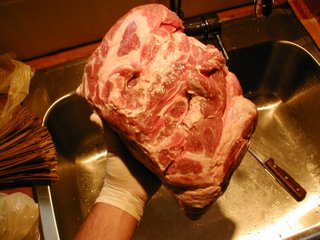
The past couple of years I have done a brisket bbq but this time I bought a pork butt for pulled pork ( about 8-1/2 pound bone in). However the neighbors wanted a Mexican theme. So how about pulled pork tacos? 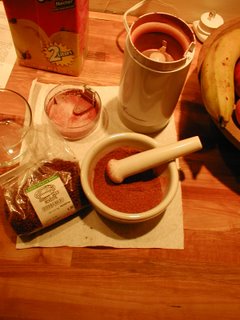
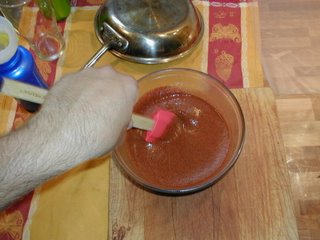
Rick’s recipe called for blending achiote seeds (I learned they are also called annatto seeds, which made them easier to find) black pepper, cumin, Mexican oregano, cinnamon and cloves, stir that into lime juice and orange juice, and throw in a handful of cloves. Put your butt into the marinade and let it soak overnight.
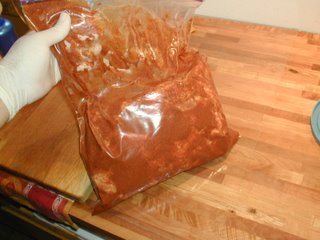
Now the recipe calls for cutting the roast into several slices and wrapping them in Banana leaves. Now as much as I like the idea of pork steaming in banana leaves over the pit fire, I lent my bone saw to a buddy to trim his mulberry tree, so the roast stays whole. I started the roast at 8 am figuring 6-8 hours to finish. However at 7 am I realized I was short charcoal, so a I built a smaller than usual fire. Instead of a 275F smoking temp I was at 225F. So at 5PM(the party already started) I pulled the pork off at 185F, 15 degrees short of the goal.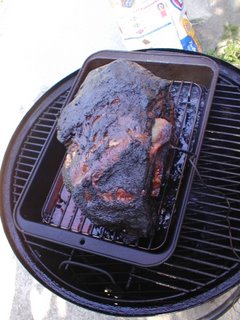
Most of it shredded but some had to be sliced. Again to hammer home the point, on tough cuts of meat (pork shoulder, Boston butt, beef brisket beef plate) you cook them low and slow to allow the fat to render (“self basting” in the Taco article) and the connective tissue to break down. The results is moist and tender meat. Most of the rendering and tissue break occurs past 160 F, so you got to keep on going.
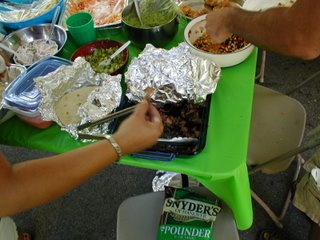
Anyway Taco time. The night before I also sliced some red onion and marinated it in 2 parts lime juice (limes were twelve for a dollar) and 1 part orange juice. To build a taco: Tortilla, meat, onion.
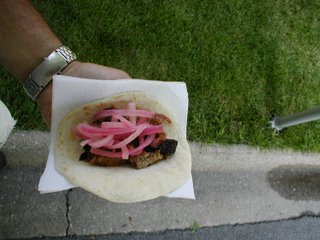
Repeat.
Notes: the Tacos were magnifico, and they where enjoyed by all the gritty Southsiders. The marinade only called for 1 tablespoon of salt, I’d maybe double that next time. The onions had an exquisite color but they needed a bit more sweet. Next time make sure you have enough charcoal.
Cheers.
Subscribe to:
Posts (Atom)