18 January, 2007

Hunt for Prosciutto


Do you remember the first time you had prosciutto? I do, about fifteen years ago, it took me about a year to not be afraid to pronounce it right. Since then I have become fascinated with air cured hams; so simple, just meat, salt and time. I remember when I first moved into our house(about two and a half years ago), I thought the crawl space under the living room would be perfect for a “cave” where I could cure a ham. It has been over a year now that I have been reading about the preparation and I am still not ready to go for the whole leg. However here are the results of the first test.

The experiment started the first week of December, with a recipe for Lardo from Ruhlman's Charcuterie book. I used a couple of pieces of pork belly; they cured in the fridge for ten days, then into the drying box.

Day one in the drying box, December 18

The drying box is an old cabinet I saved from the kitchen renovation. I put some black landscaping fabric over the front to cut down on the light but still allow air to circulate.


So I let it go for twenty four days. I tried to check it daily, had a little chart to mark down the temp and humidity, kept a bowl of water in there to try and boost the humidity a bit, and after three weeks...


Okay is doesn't look too different, but they are not black and covered with mold either. Let's start slicing.


Slice this stuff like smoked salmon, hold the knife almost parallel to the meat and skim a piece off the top.

It didn't quite taste like di Parma or even di San Danielle, but it hinted at it. The texture was very nice but uneven. I think I need to boost my humidity a bit more. But in the mean time I have some perfectly edible cured meat. The Lardo recipe was more about the fat rather than the meat and it stressed that unless you had very high quality fat, the result may not be so good. Well the book was right, the fat on its own is not very interesting, but I paid $1.29/lb for my pork belly and with a little salt and a little time I got something very delicious.

Okay so you're not ready to start hanging meat in your basement but you want some prosciutto, Here are some interesting places to go:

Bari Foods. Grand and May in Chicago. This was where I first tasted prosciutto. It is a nice little Italian grocery store that has become very famous for their sandwiches. If you want a sandwich, get the prosciutto and fresh mozzarella. They also make their own sausage on premises, my favorite being the Barese sausage.

Caputo's. They have a couple locations, I have only been to the one on Harlem. Unbelievable Italian grocery store Mecca. Very good prices. Make the trip, it is worth it. Very Very crowded on Saturdays and Sundays.

Scott's Market. Just North of Route 30 on Western AVE. in Chicago Heights. For my petit saucissons in the Southland, this is a good place to go. They have a well kept deli case, a small selection of Italian imports, and incredibly good sausage made by the folks who ran the Specialty Shop.

And for my friends in the CMH, I am sure there are lots of good places to get prosciutto, but why mess around just go to Carfagna's.

Cheers.

PS. For pronouncing prosciutto say PRO-shoo-toh, if you are at Caputo's you may have to add the word Crudo, less you get boiled ham. And if you happen to be in Brooklyn, square it off and just say PRO-shute.

10 January, 2007

New Sausage stuffer New Sausage Recipe


The Crankman.

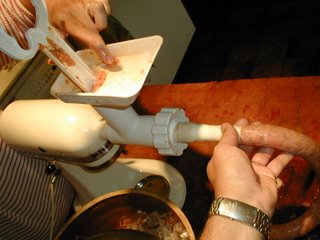
Making sausage is not a very complicated. Some instructions, a grinder, a stuffer and you're off. I been using the Kitchen- Aid grinder attachment for the stand mixer. It's a good deal if you already have the mixer. I also have the stuffing tubes. I like the grinder fine, perfect for anyone making 5 pounds or less (and that's a lot of sausage). However the stuffer attachment leaves something to be desired. It works by pushing the mixture into the casing with the auger. Not only do I not like the idea of the mixture being smeared around by the screw, but it is not very efficient. It feels like walking up a sand dune or trying to jog in mud. Additionally, the stuffer attachment is really no good for an emulsified sausage like hot dogs, the mousse-like texture simply smears everywhere. So I started looking at stuffers. I immediately passed over the elbow shaped stuffers as a poor design, a mess in the making. The next step up is the canister stuffers, the right design, but yeow-geeze the price, for a five pound capacity you're looking at two hundred bucks. That's too much. Then one day I found a stuffer on an industrial tool website. Northern Tool and Equipment has a sausage stuffer for $79. I was smitten, but why so cheap? Before I could track one down for a close quality inspection, Santa put one under the tree. I have used it twice and my initial impression is I don't know what a $200 stuffer could do better. I need to bolt it to something (there are bolt holes in the base) and I may upgrade the plastic stuffing tubes to stainless. The tubes have a rough finish and it is kinda (not too bad but) hard to slide on the casings.

It is pretty simple: A crank arm gears to a threaded rod that has a plunger on the end. The plunger has an air release valve and rubber o-ring to seal against the canister. The whole thing comes apart for easy loading and clean up. For operation, I chilled the canister in the freezer, then I used a little lard (called vacuum grease in the industry) around the o-ring and on the stuffing tube. H did the cranking (so easy a four year old could do it), he thought it was kinda like playing with play dough (pause here for deeper philosophical thought).

The first sausage we made in the new stuffer was Friulian Sausage recipe created by my Man in the Oranges, Brian. He said he wanted to recreate the sausage he once bought made by Mario Batali. What he came up with is very very good. It comes across very subtle but well rounded and is equally at home served with pasta or served with a smear of mustard. But first what is Friulian? Friuli is part of Friuli-Venezia Giulia, an region in northeastern Italy. By the way, if you are just metacrawling through, here's Batali's recipe for Friulian Sausage, I'll wait while you look...

Okay you back? I think Batali's recipe is ok, pretty simple, it has your quatre-epices, and some garlic but I don't know about using lard, that seems like a bad substitute, just get some pork fat. AND like I mentioned earlier, 5 pounds is more than enough sausage for making at home, Batali has you working with 6 pounds including the fat. If you want to try this recipe (I'm not) just make half of it. But I digress...


You should make all of Brian's recipe. We ate a little less than half of it New Years Eve, had some for a dinner party last Sunday, and a couple links left over for lunch this week. This stuff really freezes well. He departs from the usual Italian sausage with ingredients like whole mustard seed and juniper berries. Here's his recipe that I made with 4-1/4 lbs. of pork (see notes):

4-1/4 Lbs. Pork shoulder
32 g Salt
8g ground pepper
7g whole black mustard seed
7g whole coriander, toasted then slightly crushed
16 Juniper Berries, crushed
200ml red wine chilled

Dice pork shoulder and mix in all ingredients except wine, refrigerate mixture for an hour up to overnight.. Grind mixture through small plate into bowl sent in ice, add chilled wine and mix medium speed with paddle attachment to get a smooth consistency (about one minute). Stuff into hog casings. If you have time let them air dry in the refrigerator for a few hours. Cook and enjoy.


mustard from the MustardMan


Notes: Brian's recipe calls for white wine, but I didn't have any. I also (with a nod to my wife) put in a little sugar. I used pork belly that I had trimmed from another project. To adjust the ingredients to the weight of meat that you got, find the ratio. Take the wt of the meat that you have and divide that by the wt in the recipe. Take that number (the ratio) and multiply it to each of the ingredient amounts. Hey Presto.

While I'm on the subject of conversions, I found a great posting for converting weights and volumes in cooking. The blog is called Chocolate and Zucchini.

I gotta go cook.

Cheers.

02 January, 2007

Apres Holiday

16 lbs. of smoked prime rib

Green chile and chicken tamales.


Back to work my gentle readers. As you can see off to the side here we have two new ways to get updates: Notify email by Notify.com OR the RSS feed. I will probably faze out the Notify subscription list in favor of the RSS feed. Since Blogspot does not power its own RSS, the feed is run through another website called Feedburner. Everything seems to work good and it has not done anything evil to my computer. Get the feed. Also off to the side I have put up a new link to my flickr page. If you are really bored you can click over there to look at family and food photos.

As for updates, I resolve in this new year to put up at least one a week. We also have some new contributors: JL is to report on the food ways in Addis, and the Mustard Man from D’dorf is scheduled to chime in with lifestyle tips and food trips from the Continent.
But first I want to hear from you. How did you do on your the Holiday Meals? Leave comments detailing every morsel. I’ll go first.

Cheers.

22 September, 2006

Building a Cold Smoker: The summer sausage episode part 2


Dear Gentle Readers:

Sorry I have not updated you sooner. Didn't realize the summer sausage would become such a cliffhanger; a regular who shot J.R., huh? For all of you writing in clamoring for closure, I'll give you the short answer so that you can get back to work translating German or whatever it is you do between instant messages, everything turned out very nice. As for the long answer, well....

If August is the Fairest of Months, then September (October too) is the shank of the year. It is the beginning of the season for the art world, school, tv and, oh yes, OSU football. The garden is still plump with tomatoes, squash and eggplant, but the weather is starting to nip. It is simply a beautiful time I feel best enjoyed by sitting around a table with friends and family enjoying something good. To that end I have been cooking like crazy and I have a bunch of episodes ready to go. Future updates may include: Chorizo in the morning, My First Pate, Bacon Madness, and Jerry's Kielbasa. But as we are here on the last day of summer let's finish what we started.

The summer sausage episode part duex.

So we left off last time with sausages hanging to dry in the refrigerator. The recipe called for ten hours or drying, it ended up being two days. So after a couple of days I finally had time to set up the cold smoker.

3. The Rig


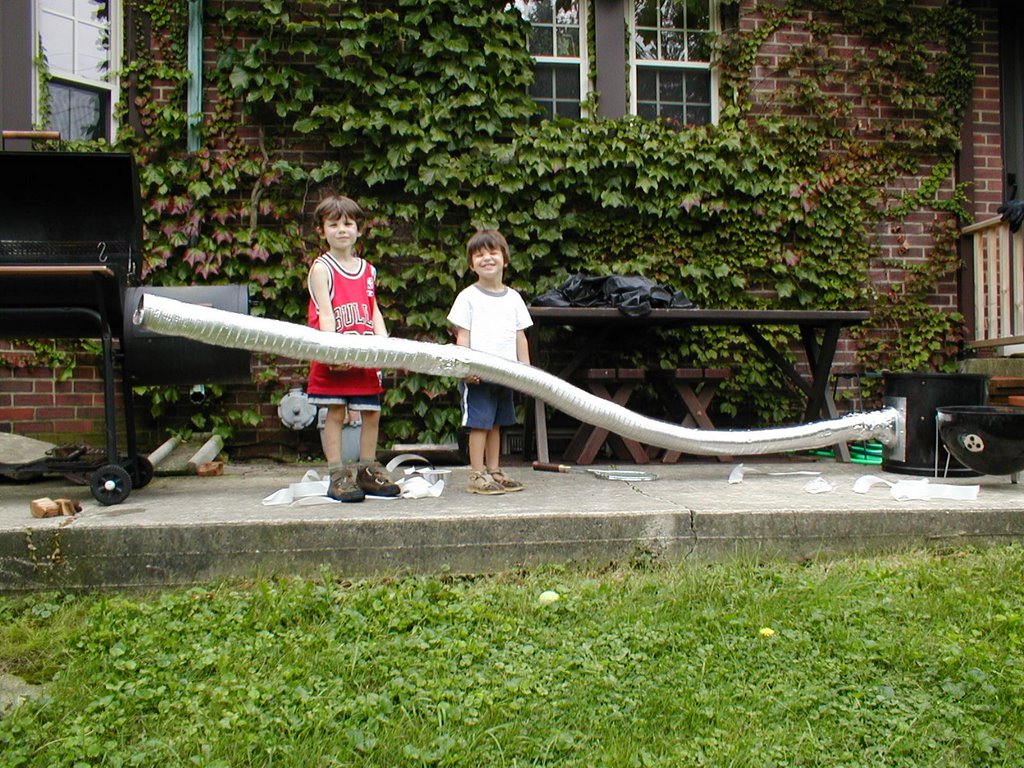
I didn't do a whole lot of research on this design, I needed to get the smoke out of my Weber smoker and into my other grill and reduce the smoke temp to under 100F. Me and the boys made a trip to Menard's.


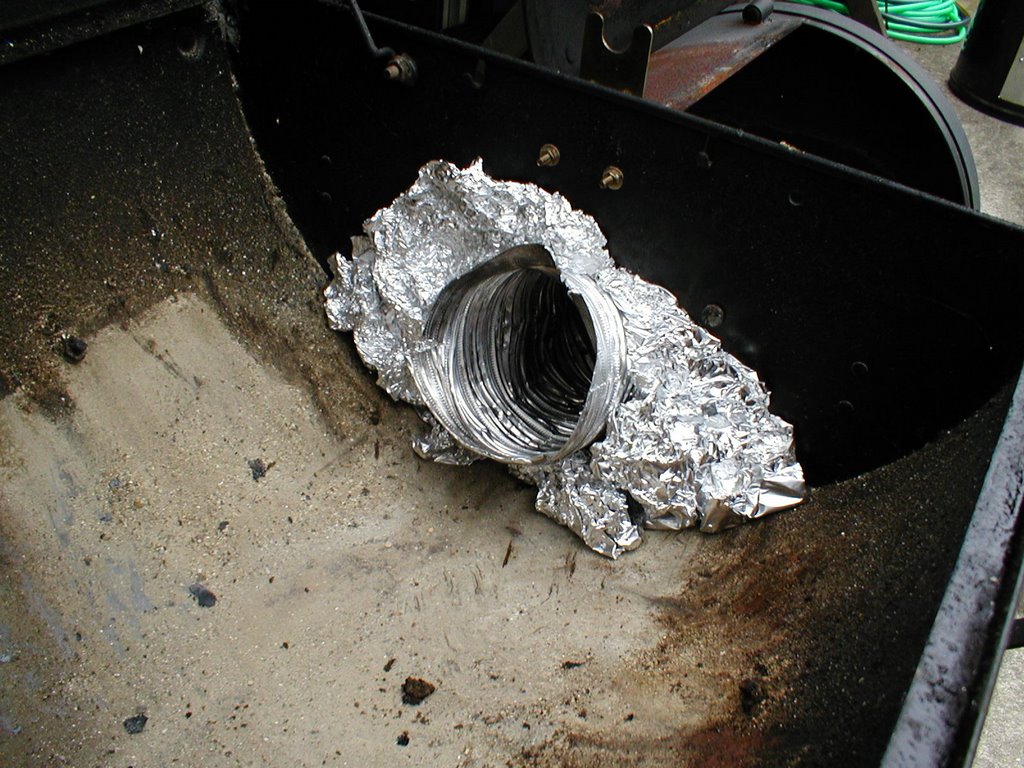
We picked up a galvanized roof vent thingy and some aluminum dryer vent. I fashioned the roof vent to fit into the fire door access on the smoker. I secured it with toggle bolts.

Next I attached the dryer vent tubing. I first tried foil tape, but learned quickly that the adhesive fails at temperature. Some drywall screws solved that problem. Time to get the rig smokin.


4. The smoke

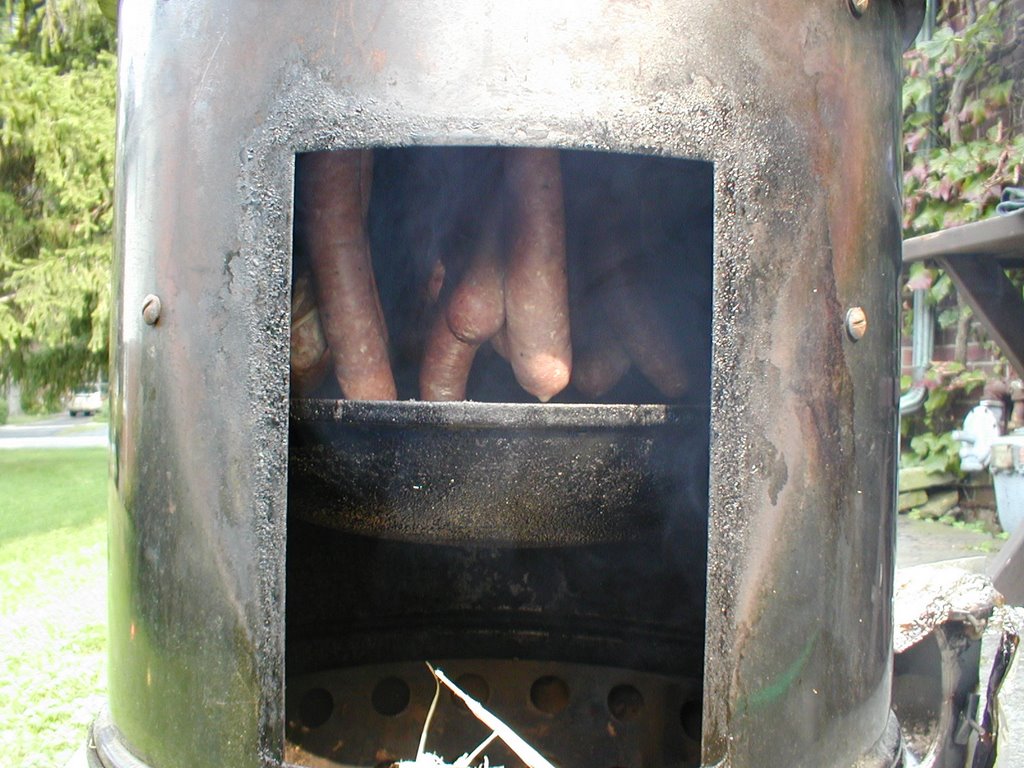
The cold smoke temperature stayed around 90F. I let it go about 4 hours then I hot smoked the sausages to an internal temp of 150F. To raise the temp I simply moved the meat. The hot smoking took about an hour.

For the fire I started with a little charcoal then used split hickory. Since I kept a small fire, I had to tend to it a lot. I suppose you could use the wood chunks that Weber makes but I would trim off the bark first.

So why cold smoke? For smoke you need fire, fire cooks things, so if you want to put a lot of smoke on something without overcooking it, cool the smoke. One of the concerns in holding meat in the 100F zone is that bacteria can thrive; the meat must be cured.

After the cold smoke, the sausages did not look much different but after the hot smoke..Now that looks like sausage.


special thanks to the boys for providing the risers.

5. The finish

So anyway the thuringer and the summer sausage were among the featured attractions for an office party S put together. The German guy from the Dubai office said he had never had thuringer cured and cooked like this but he thought it was good. The guy from the international sales department wanted to know what made the summer sausage spicy, I wasn't sure..Maybe the combination of pepper and the smoke? I had forgotten that I had put in a secret ingredient.


Secret ingredient.

As I mentioned in the previous post (I know, so long ago you forgot) The ingredients for both sausages are virtually identical except one is beef the other pork. Additionally, The pork thuringer had whole peppercorns while the summer sausage had no pepper at all. The spicy flavor came from ground mustard. In the thuringer I used plain old Coleman's mustard powder, but for the summer sausage, I ground up whole black mustard seeds (see photo). I picked it up at the Spice House. I think the mustard made a made the difference. While S thought both sausages were good, I thought the summer sausage was way better. The thuringer seemed rather one dimensional. The fermento was very interesting, both sausages had that salami "tang."

As for cold smoking, it idefinitely worth the trouble. I recently used the rig to smoke bacon and kielbasa. I'll have to do some research to maybe simply the process. A lot of cold smokers use hickory sawdust to create the smoke, maybe that's next. In the mean time I will try to keep you up to date on the state of the sausage in a more timely manner. As fall brings in the cool weather it is time to work on dry curing salami and maybe some guanciale.

Cheers.

P.S. Update on the Prickly Pear Episode: After a month in the basement we had a syrupy tart purple liquid which no one bothered to mix into margaritas. To drink it straight it was peppery, then floral, then a sweetart pucker followed by a hot breath that went through your throat out your shoulders then tingled down your back. Needless to say the entire liter was drunk in one night (the office party). All that was left was several plastic cocktail cups half full of maserated fruit. I said the fruit was too seedy to be eaten(like giant raspberries with seeds the size of Mini Chiclets) but once you start chasing the prickly pear, I guess you have to find out for yourself.

23 August, 2006

The summer sausage episode part 1

August in the garden. See previous post regarding feelings on August.

The summer sausage episode part 1

1. The Get

I paid twice as much (per pound) for four times as much as I wanted, and I said thank you.

Saturday I went to my local meat packer/processor, twice. Even though I have been there five or six times in as many months, when I go, I still have the nervousness of a tourist asking for baba ganoush in Beirut. The first time we pulled up an older man was walking out from one side of the building, chasing off the casual pecking chickens in the lot, cursing in a combination of English and some eastern European language. He wore a white coat with a white apron and heavy boots. It was uncomfortable with how he yelled; I felt like I was in a stranger’s back yard where a father was yelling at his children to pick up the toys for the tenth time. I followed him towards the store, he went in the out doors, I went in the in doors. I looked around there were maybe ten people in line maybe another ten at the meat counter. The old man stood at the end of checkout preparing to bag still grumbling. The woman behind the register said to him, "It’s okay Dad." He turned and looked at me as I was surveying the crowd, and said gently: "I hate it when it gets crowded, it should be McDonald’s, fast service, but the people are not so fast."
"I’ll come back later."
"No, no don’t worry, take a number they will help you."
"Yeah, I’ve got the kids in the car, I’ll come back, thank you."

I came back about an hour later and it was empty. I asked for some jowl, The man, clarified my request: "Pig?" He squeezed his cheek, "Cheek?" Yes. He grabbed a plastic bag and walked to the back room.

The retail room of the processing plant is not very big, you walk in the meat cases are arranged in a U shape with an island of spices and additives in the middle. On one side are open cold cases with packaged chicken, beef, sausages, tripe hooves, trotters and various smoked and cured bits. Forming the bottom of the shape are two glass cases one with chicken and catfish, then another with beef. On the far side there is one case for lamb and three for pork. Each of the pork cases get gradually more interesting starting with pork chops and loins, then finishing with bellies, ears, and snouts.

At the corner between the beef and the lamb case, a small cutting table was set in the crook. The man returned with a large piece of meat in his arm. He set it on the table.
“how much do you want?”
“Just one, I just need a pound”
It was a pig’s head.
“Skin on, skin off?”
“Skin off, please.”
He took a long knife and started at the ear. No good. The knife was dull, he looked around for another, then he walked to the back room. It’s not too often you see a pig’s head, he had big ears and blue eyes. I started to feel a little queasy so I turned away.


The man returned with a short knife and quickly went to work. I leaned close to watch. He made a light cut below the ear then with his fingers he pulled the skin, it came off like a wet sheet of wallpaper. With bigger cuts he worked the cheek off and down and around the jaw line. Side two, repeat.

“Four pounds, you want...” He starts to remove…
“No I’ll take them both, it’s beautiful, thank you.”


Diced Jowl

2. The Prep

Good thing I got two cheeks, each one yielded only eight ounces of pure fat, which was a little less than what I needed. The recipes are thuringer and summer sausage. I had planned on only making the summer sausage when I realized that I had the ingredients on hand for both. The recipes are almost exactly the same except that summer sausage is mostly beef, and the pork thuringer has the added ingredient of whole peppercorns.

Both sausages are fermented, in this case, the fermentation is simulated by an ingredient called Fermento. Fermento (according to the cookbook) is a dairy based product that creates a tanginess that is similar to bacteria fermenting over a long period of time in a controlled environment. But we only have three days and a fridge. Fermento looks and smells like really sour powdered buttermilk. The other ingredient making its first appearance is dextrose. We’ll use that (again, according to the cookbook, I’m following the recipe this time, I promise) in place of sugar because it more readily distributes in the mixture. Each recipe calls for grinding and mixing together the ingredients, then a fermentation period: For the thuringer, three days, for the summer sausage two.

It's like watching sausage being made.

After I let them sit for a few days I ground them again and stuffed them into casings. Now put them onto smoke sticks and let them air dry…wait a second who has smoke sticks?

How about some stainless steel S hooks from an old IKEA pot rack. After drying for ten hours cold smoke…wait this is getting complicated, a cold smoke? Ice cubes in the water pan? Tune in next week we’ll see what happens.

cheers

17 August, 2006

Columbus….Oh. – Chicken Sausage and Peach Sangria Recipe


"Fairest of months! Ripe summer's Queen,
The hey-day of the year,
With robes that gleam with sunny sheen,
Sweet August doth appear."

At least that is what it says on one of my mom's placemats. I believe those lines should be attributed to Gillian Douglas, but a Google search did not turn up much on her, maybe because she's Canadian.

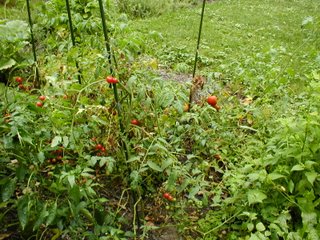
But August is the fairest of months, the sweetest of summer, we start to get some cool nights, the garden is mature, tomatoes and peppers must be picked. It is also my favorite time to visit the family homestead in Columbus.
Hello girls.

JL hitched in for a short visit too. She is off to Ethiopia next week and has promised dispatches from the New Flower (Addis Ababa) for our humble blog. She'll be there for a year. To send her off in a proper fashion I figured to make some sausage. JL said she hadn't had a decent chicken sausage and wondered if we were up to the challenge.

We went to Weiland's Market for supplies. Weiland's has been in the Clintonville area forever and it has always been the place to go for meat. About six years ago they vastly expanded when they took over a space that used to be an A&P (Yeah, I remember when it was an A&P, and Volunteers of America was a Buckeye Mart). Now they offer an extensive selection of gourmet stuff, perfect for the summertime party. We picked 3 ½ pounds of chicken thighs, some pork fat (trimmed on the spot and free), a few Ohio peaches and bottle of Piesporter Michelsberg.

Making sausage is relatively easy, but there are some details to follow and I recommend you read about it. Some good books are: Charcuterie: The Craft of Salting, Smoking and Curing, Bruce Aidells' Complete Sausage Book , or Cooking by Hand. You should be able to get any of these books at the library. As for equipment, you need a grinder and a stuffer. Provided you have a Kitchen-Aid Stand Mixer, the easiest and cheapest way to get grinding and stuffing is with a grinder and stuffing attachment. The Charcuterie book offers specific instructions using this equipment.

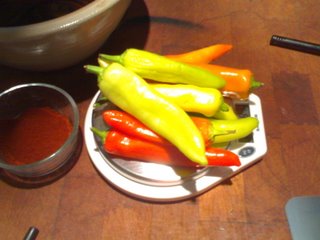
I don't know what kind of peppers these are, but the red ones are kind of hot.


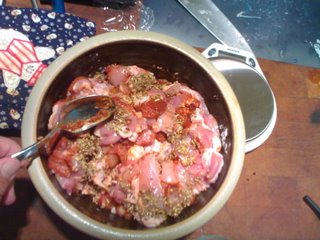
Now for the sausage. We got some mystery peppers out of the garden (I say mystery because we only bought poblanos jalapenos and sweet reds and these look like none of the above), roasted, cored, seeded and chopped them up for the mix. I diced the Chicken and the fat and tossed them with some cornstarch. The cornstarch idea comes from stir-fry; a cornstarch dusted meat retains its water, I dunno it works in the Phad Thai, see if it works here. Then I mixed in the toasted spices, and some garlic and a let it sit for a hour.
Let it sit longer if you have the time. I put the mixture in the freezer for ½ hour before grinding. Then I ground it into a bowl sitting in an ice bath.
You gotta keep the sausage cold or the texture will be bad. After grinding, I mixed the sausage with the paddle attachment for about a minute adding the vinegar.

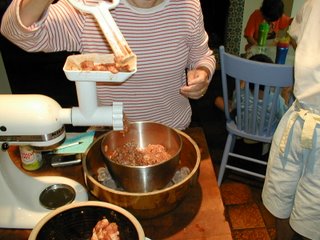
Mom helped with the stuffing.

Time for the grill. As you can see here our little sausages are bursting at the seems. JL asked why we didn't boil them first. I gave her a long winded answer that wasn't entirely accurate but after a little reading here's what I should have said: Boiling (more accurately poaching in a water bath 180-200F, which I did say) is a good way to get a sausage up to temperature. It's gentle and accurate. Cook a sausage to 160F (maybe a little higher for chicken), beyond that cooking just dries it out. However poaching imparts little flavor; Grilling has the best flavor. The problem with grilling is controlling the heat. If a sausage cooks too fast it may burst and get over cooked. Grill over medium heat. Our fire here was a little hot.

Time for dinner. Some tomatoes from the garden chopped up with some fresh mozzarella, corn pudding from grandma, and to drink peach sangria. With peaches in season what could be better.

The sausages turned out very nice. Usually a chicken sausage has dry and flat taste, but I think the added fat and the roasted peppers brought the meat around for a full flavor and plenty of moisture. I don't know if the cornstarch helped with the moisture issue, I'll try it sometime without it. The ingredient list follows.

JL adapted the peach sangria recipe from Bon Appetit, August 2003. 1 bottle of white wine, 750 ML of white cranberry Juice, ½ cup peach schnapps, 4 peaches peeled and sliced and 1 lemon sliced.

Italian Chicken Sausage with roasted peppers.

3-1/2 lbs Boneless skinless chicken thighs
¾ lb Pork fat
8 oz (weight before cooking) Mild peppers (Anaheim)
2 Cloves garlic, peeled minced
30 g Kosher flake salt
20 g Paprika
16 g Whole fennel seed, toasted
8 g whole coriander seed, toasted
2 T Cornstarch
175 ml Cider Vinegar

Cheers

16 August, 2006

The Jalapeno Episode


A few weeks back I said to look out for a future episode involving three pounds of jalapeno peppers. I came up with a recipe for Jalapenos en Escabeche, but it didn't turn out so well. I believe my main problem was that it got too warm in the basement. The texture seemed fine and, beyond the musty smell, the peepers had a nice pickled aroma. We will try again soon and hopefully present a positive report.

Before. Peppers, carrots, garlic, onion, water and salt.

After. One week later.

02 August, 2006

The Mail Bag - Slow Pork Taco Recipe


[Dear SMAC,]

Ha! I did find a 3# pork shoulder chunk at the ShopRite on Monday. I'd like to do a rub/marinade and grill it the next day for tacos. No achiote seeds on hand but I have everything from Bittman's carnitas recipe in the Times last week. Any suggestions on the marinade? Should I try to add some wood for smoke when I grill it? What temp am I shooting for internally? Do I need to add something to make steam when I grill it?

Signed

sweatin' and grillin'
West Orange, NJ

Dear SWAG:

There’s always a wise guy out there tryin’ to break yer shoes. I’m sure you could find a three pound piece of shoulder in the crammed, family of six studio apartment dwelling, environs of NYC; there is only so much you can fit into one of those Holly Hobby Easy Bake Ovens. But all jabbin aside, how about that heat? Do not try to make sausage in this kind of weather it’s just too hot, but my order of Fermento and Dextrose showed up today so we are going to get down to business soon.

Now about grilling three pounds of pork shoulder. First about the Bittman article, seriously, it looks like page 298 of Rick Bayless Mexico, One Plate at a Time except no achiote or banana leaves. Go to the library and check it out.

But anyway, following the carnitas recipe I suggest the following changes:

For the marinade I would replace the lemon juice with fresh squeezed lime juice and bump it up to at least ¼ cup up to ½ cup. Bump up the salt too, A heavy tablespoon. I not sure about the authenticity of coriander, it is good for Italian sausage but tacos? Skip that , Instead put in some cloves, less than ½ teaspoon. Double the cumin and double the peppercorns. Put some cayenne in too. After toasting toastable spices (toast only whole spices), grind that all up as powdery as possible. Take your powder your garlic and your juice, and blender until smooth. Put the meat a Ziploc pour in the marinade, message well, and let it go overnight in the fridge.

Now for cooking. Since I know SWAG has a kettle grill (Weber 22”), that will be our weapon of choice. It is actually a perfectly good tool for smoking, especially with such a small piece of meat. First let’s set up the grill: Get some aluminum foil. You are going to build a small charcoal pile (I dunno 15-20 briquettes) on one side of the kettle. Build a wall of foil to sequester the pile with a little room to add more charcoal. Now the foil is not as much a retaining wall, but a heat shield, and a reminder to keep the fire small. Now you can buy some Charcoal Briquet Holders for that fancy pants look, but foil will work just fine. Try to line the rest of the charcoal grate with foil or use a drip pan because it is going to get messy. Fire up about ½ chimney of coals throw that on top of your little pile coals, a couple small chunks of wood (Hickory, I know you have some, I try to avoid bark) and see if you can get your fire to stabilize between 250 and 300F. How do you know when your grill is at temp? Go get a thermometer. For my mom’s kettle I picked up a Weber Grill Food Thermometer and ran it through a cork and stuck it in the vent as pictured here. If I want to control venting, I use balled up pieces of foil.

Arrange the cooking grate so that the handle is over the fire; there will be enough room to feed the fire without removing the grate. Or again, for that fancy pants look, you can get a hinged cooking grate ( I got one of those for my mom too). When cooking like this, I do like to put a pie tin of water over the fire for a little steam. I haven’t done any research and since the meat (a particularly fatty cut anyway) has been marinating, I don’t know how much difference the steam makes, probably not much. I figure it is not too much trouble( make sure it is a pie tin the old lady doesn’t care about, sorry mom), and the water helps regulate the temperature, so what the heck.

It is going to be around 3 hours to get 3 lbs of shoulder “Fork Tender.” What Internal temp is fork tender? 200F. Just cook it as long as you can stand it and look for it to be done anywhere between 190 and 200F. Now I am not positive about this smaller cut of meat, but you may find it races to 160F, then plateaus, and crawls the rest of the way to 200F. Try to keep the temp constant, and throw on another chunk of wood if it isn’t smoking.

Mac’s Modified Slow Roast Pork for Taco Recipe Ingredient List

10 cloves garlic, peeled

3 pounds pork shoulder, preferably boneless and in one piece (whatever)

1 Tablespoon peppercorns

1 teaspoon (or more) dried Mexican oregano (or Greek, don’t bother with fresh unless it is in your garden, which it should be)

1 Tablespoon cumin seeds

1 teaspoon cinnamon powder

½ teaspoon whole clove

½ teaspoon cayenne

1 Tablespoon salt

2 Tablespoons fresh orange juice

¼ to ½ cup fresh lime juice.

Now I just made this up. I haven’t tested it, tune it to whatever makes sense to you, but it sounds good to me. And do the pickled onions, they are really good. Bayless' onion recipe calls for 3 red onions sliced, 1 1/3 cups lime juice, 2/3 cup orange juice. Marinate overnight. With a three pound roast, you could cut that recipe in half. And add some sugar. For pictures of an 8 pound roast marinating and the pickled onions, see the South Side Tacos post.

Thanks for the question, keep em coming, and SWAG, send us some pictures of your baby roast!

Cheers.