07 March, 2010
08 July, 2009
01 June, 2009
Carnitas Pibil and a lesson in the ways of BBQ

Pork tacos and a lesson in the ways of BBQ.
I am now positive that my favorite barbeque is pork shoulder rubbed with Achiote and spices. It's a preparation from the Yucatan known as Pibil. I originally started with a recipe from Rick Bayless' One Plate at a Time, but I have done it (and written about it) so many times that now it comes together on it's own. I assure you there are few things finer that a picnic of pork tacos. With fair weather finally forcasted, I decided to make pork tacos over the weekend.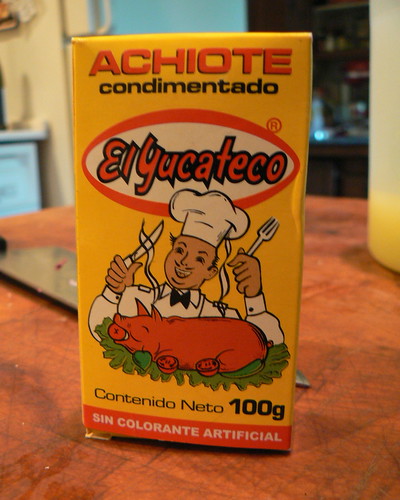
Now you can try following Rick's recipe get some Achiote (annatto) seeds, try grinding them (Like grinding pebbles, very gritty, typically you make a flavored oil with the seeds) OR you can do what everyone else does in Mexico and pick up some paste. I combined garlic, salt, marjoram, thyme and Canela (Cinnamon)with the achiote and added enough olive to make a paste.
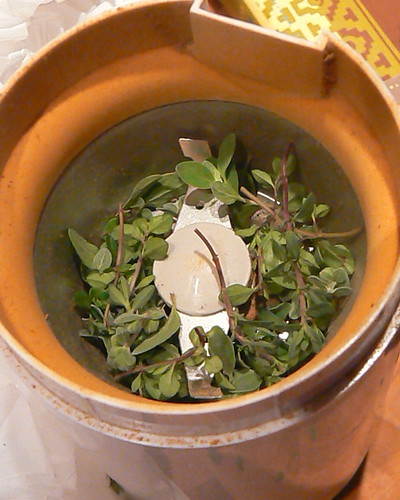
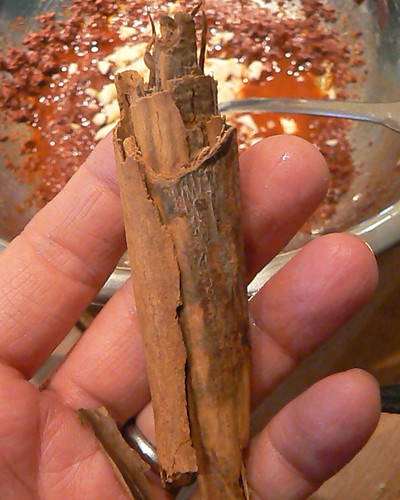
I rubbed this mixture on the pork shoulder.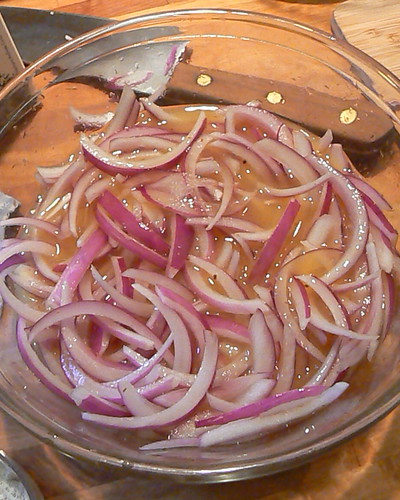
I also started some sliced red onion to pickle in lime juice orange juice sugar ans salt. Overnight in the fridge for both of them.
[
[
[
[We interrupt this post to answer the MAC BBQ Hotline]
[PHONE RINGS]
MAC: Hello?
J*$h: (name obscured to protect privacy) Hey, what are you doing?
MAC: Just started marinating some pork for bbq pork tacos, wanna come over?
J*$h: I can't, got company coming, Pork tacos, that's sounds good, do you have a recipe?
MAC: Sure I'll send you Rick's.
[NEXT DAY VIA Email]
J*$H:
Hey you only sent me an ingredient list, how about some pointers?
1. Such as a basic rub I can use?
2. how long on the grill (est.)
3. will I need to add coals/wood as it progresses?
4. what internal temp?
MAC:
Sorry about that. I don't think you will have enough time to do a shoulder roast on the grill today, it takes six hours. Get some pork shoulder steaks and rub them with whatever ingredients you have that closely match rick's recipe. For Achiote seeds use paprika (and maybe a little turmeric if you got it), for the Mexican oregano use dried marjoram, black pepper, cinnamon,salt, garlic, olive oil, mix that together and squeeze in a lime and rub that on the steaks. let em sit for a while, at least while you get the fire ready.
2. You wanna cook these things as long as you can, after an hour they will be safe to eat but chewy. The longer the pork cooks the more they will tenderize, just like working a crock pot. BTW the pork should be in a pan or something so can baste them from time to time.
3. For the fire you want a small fire off to one side. You want the fire to run at 250-350F. Once you get it going you need to check it like every 20 mins. Add briquettes if the fire is going out, add wood for flavor as needed. It doesn't need to smoke like an old Chrysler tho.
Dave at weber_cam has a good dicussion about lighting an indirect fire on a kettle
4. As for internal temp, I'm going for 200F on my roast, but that is going to take forever. You pork steaks need to get to at least 160F but they wont shred until the temp hits maybe 190. You're gonna chop this stuff up for tacos anyway so pull it off when you're ready to eat. Good luck let me know what happens
[MEANWHILE Back at the Ranch]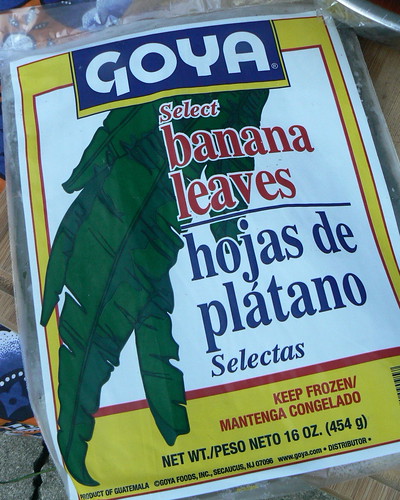
I got some banana leaves. I Pass them over a hot grill to soften them. They darken slightly. I line a pan with the leaves, nestle the roast then cover with more leaves. Enter the smoker.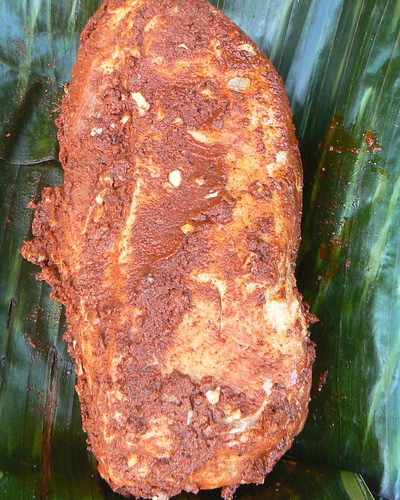
I slow cooked the pork for about six hours, I got the internal temp to about 195F. I was busy doing garden work so I shut the vents and let it sit for another couple of hours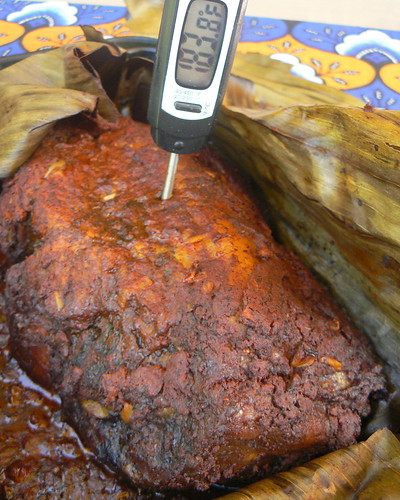
Time to pull the pork.
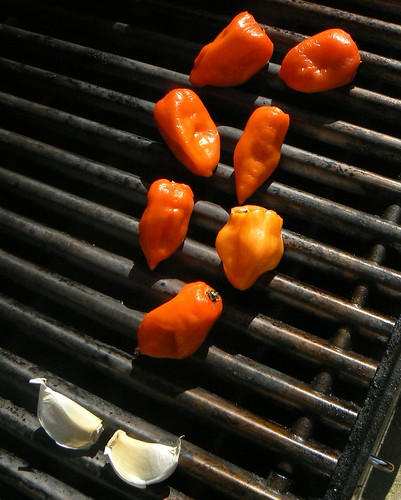
I roasted some habaneros, garlic, blended it with lime juice and salt for a hot sauce.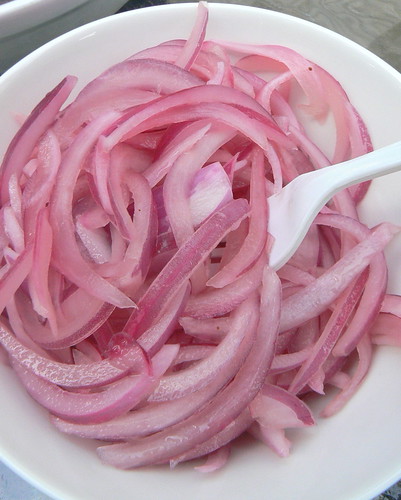
The pickled onions are done.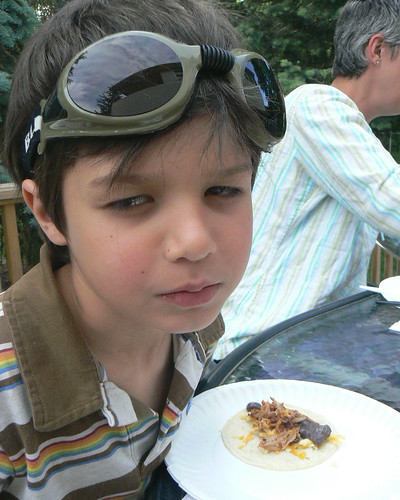
It's a beautiful day to eat tacos.
[
[
[
[
[MEANWHILE J*$H writes another note on the MAC BBQ Hotline]
J*$h:
I Made the tacos - everything went fine, but mostly done in the oven. We had to meet friends at Morton, so we threw it in there for a head start (4.4 lbs bone-in shoulder) at 250. Got back 3 hours later, and it was just about done. Not realizing that, I had started the coals, so I threw it on for 40 minutes or so, just to do it. Not sure if the taste changed much. Rub was lime juice, chili, cumin, ancho chili, lots of garlic and kosher salt. A very positive experience I must say, delicious all around. Also made a corn relish I saw bobby flay make - corn, charred jalapenos, cilantro, red onion and lime juice. Good, too. And of course, autentico tortillas.
Thanks.
[Hotline disconnects, MAC is troubled but then enlightend]
A very positive experience? How can that be? I gave J*$h somewhat explicit instructions on how to BBQ and he ignored them. Maybe the lesson today isn't for J*$h but for me (and any other would be BBQ expert). It reminds me that BBQ isn't taught at culinary school. Sure they have catering classes for feeding 700 but it ain't pulling sugar at Cordon Bleu. As far as I know Careme didn't codify the technique for smoking ribs in the backyard. In fact I can only think of one rule when it comes to BBQ: Don't burn yourself (that's also a culinary school rule too). I heard about a new BBQ book whose tagline is "Everything you Know about BBQ is Wrong." While flogging foodies with funny phases may sell books, It goes against what I pontificate on this blog: If it works then it's right. I don't give two squirts about how you cooked the meat because BBQ is much more than just process. It's also about bringing being people together to eat. Make it good, make it yours. However if you are still having trouble, give me a call I'd be glad to help.
Cheers.
PS If you enjoy reading rants about BBQ (I don't), read my post Pig Pick

01 February, 2009
Seafood Sausage Choucroute
Wish I was a Kellogg's Cornflake
Floatin' in my bowl takin' movies,
Relaxin' awhile, livin' in style,
Talkin' to a raisin who 'casion'ly plays L.A.,
Casually glancing at his toupee.
Wish I was an English muffin
'Bout to make the most out of a toaster.
I'd ease myself down,
Comin' up brown.
I prefer boysenberry
More than any ordinary jam.
I'm a "Citizens for Boysenberry Jam" fan.
Ah, South California...
from Punky's Dilemma, Simon and Garfunkel
Indeed.
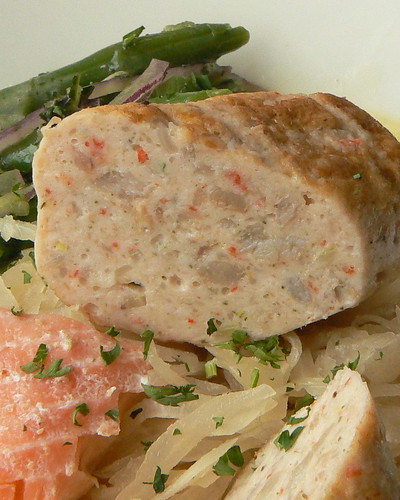
I remember hearing this song years ago, its words set the scene, I imagine myself floating in Hockney colors without a worry in the world. A couple of weeks ago we took a trip to South California (Northern San Diego County to be exact)and the scene surpassed our imaginations: Fish tacos, beer and the beach, our winter was warmed. For the trip back, Bonne Femme bought me a Sunset Magazine. At first I snickered thinking of the stacks of old Sunset Publications on the book sale racks at the library. But wait, this mag is kinda good, a hip Better Homes and Gardens, or a Real Simple with a sense of place (and purpose). On the plane I got intrigued by a recipe for Wine Braised Seafood Choucroute. It hits some of my favorite flavor points, Sauerkraut, smoked fish and sausage. It's party time.
A word about Choucroute.
Chou is French for cabbage. Choucroute is French salted cabbage or as my German pals say, Sauerkraut. Choucroute a L'Alsacienne is the comfort food of the Alsace region in which sausages, smoked meats, maybe confits de goose or duck are braised cabbage with a wine broth. But will this work with seafood?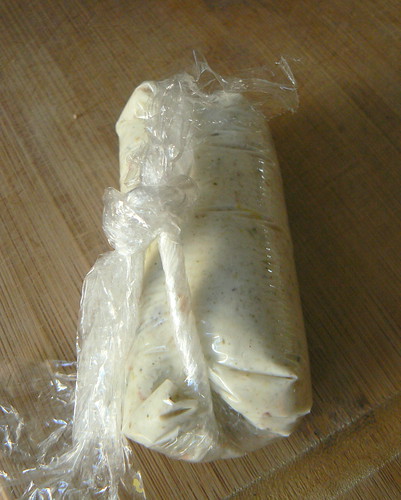
Quenelles.
For the seafood sausage I skip the "gourmet" markets the magazine suggests and turn to Ruhlman and Polcyn's Charcuterie, for a recipe. The Shrimp, Lobster and Leek sausage seems like a good start. As I am reading it I start ruminating about how seafood and sausage really don't go together: The ingredients are expensive and highly perishable, and stuffing a fish mixture into a hog or sheep casing really knocks my Feng Shui out of whack. I look around for other seafood "sausage" recipes, the French must have done something like it. Well they did, only they don't call it sausage. The secret term that links the Charcuterie recipe to culinary history is mousseline forcemeat. Escoffier defines the mousseline forcemeat as preparation of pounded meat whipped together with egg whites and heavy cream. Form this mixture using a spoon, pastry bag, or just rolling it, and you get quenelles. Thems fish balls, yo.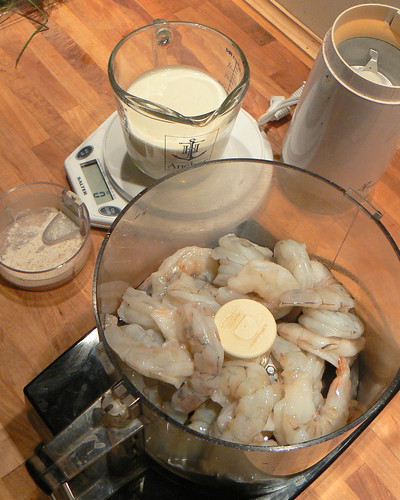
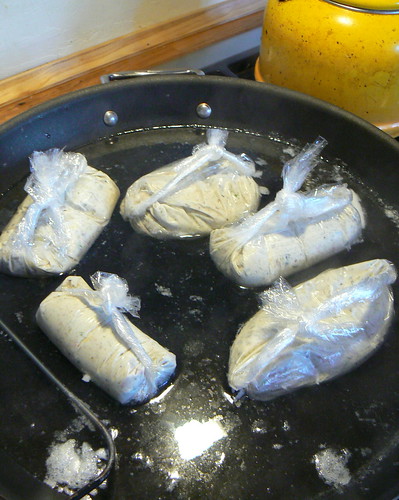
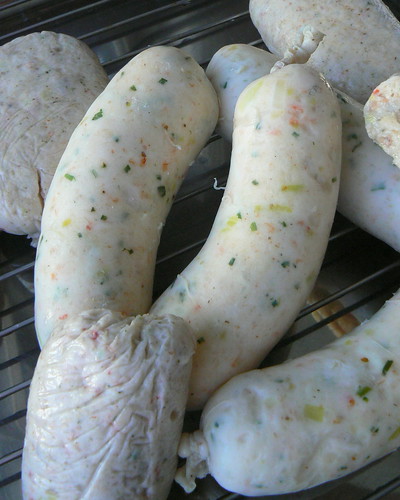
I ended up doing two batches because the recipe only made four 4-1/2oz sausages. The first batch I stuffed into hog casings the second batch I poached in plastic. I used crab instead of lobster.
Braising liquid.
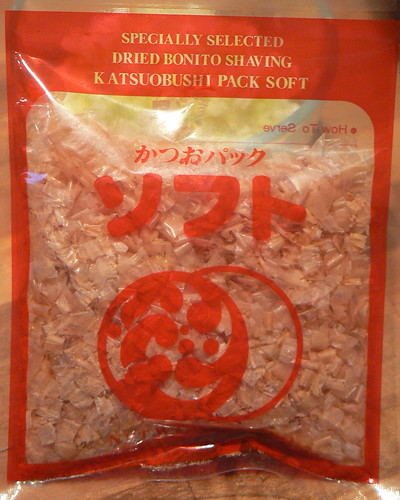
I saved the shrimp shells and sauteed them with a mirepoix of onion, fennel and parsnip. I added a package of bonito flakes for a little extra zip. The addition of wine turns the stock into what pros call a fumet, and Hey Presto, you got yourself a braising liquid for your choucroute.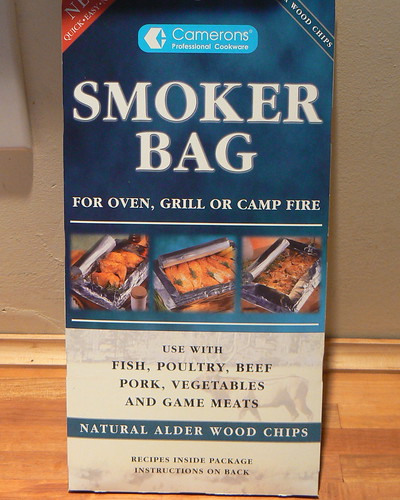
Smoking Fish in the comfort of your home.
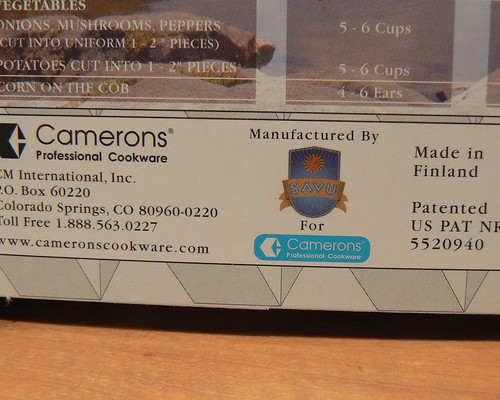
I laughed when I first saw these smoker bags at Walt's, I mean what kind of cockamaime tomfoolery is somebody to to foist on me? But when I discovered that these bags were made in Finland, I loaded up. Seriously what the Finns DON'T know about smoking, aint worth knowing. I went to this farmer's market over there where these dudes were selling hams that they had smoked in their Sauna. I gotta get me a sauna.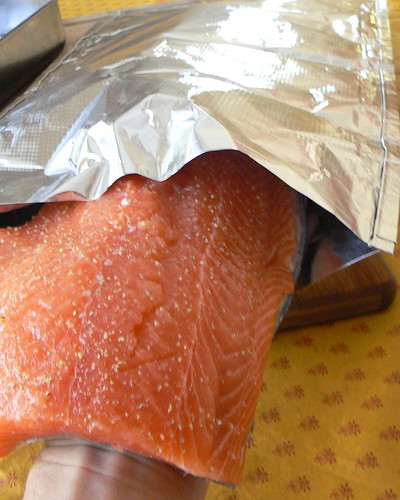
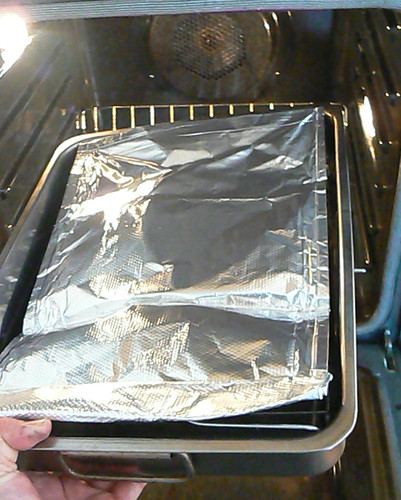
Anyway I loaded the about pound and a half of salmon into the bag folded it shut, and popped it into the oven. I could smell the smoke working, but it wasn't a nuisance. It didn't even come close to setting off a smoke alarm.
20 minutes later I had hot smoked fish. As you can see it's not very pretty and a little undercooked, but that's okay it will finish cooking when we do the braise.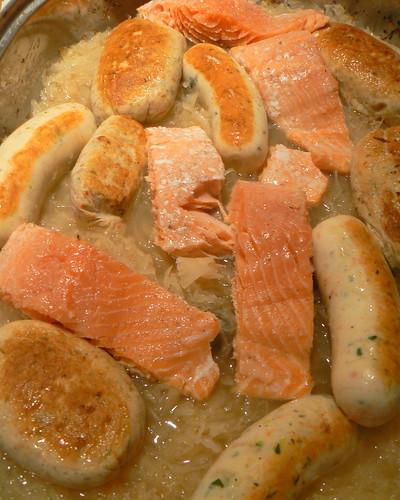
I followed the Sunset recipe and braised the cabbage in the fumet along with some garlic and a sachet containing juniper, thyme, bay leaves and peppercorns. After an hour I added the smoked salmon and the quenelles. I browned the quenelles before adding them. Heat and serve. Everything was delicious and worth the fuss. Here's the recipe I used for the seafood "sausage."
Shrimp and Crab Sausage (Quenelles)
1lb/450 g large (16-20 ct) Shrimp peeled deveined.
8 g (1 teaspoon) salt
2 g ground white pepper
1 large egg white
100-150 ml heavy cream
2 g dry tarragon
50 g leeks, chopped fine, blanched
55 g crab (whatever you can afford)
Use a food processor puree shrimp with salt pepper and egg white. With machine running add heavy cream, keep an eye on the mixture you don't want it to get too loose. And make sure everything stays very cold. Transfer to a bowl and fold in remaining ingredients. Chill. Stuff into casings or roll in plastic then gently poach until done.
I adapted this recipe from Charcuterie with input from Escoffier and Larousse.
Cheers.
17 November, 2008
Smoked Fish in the Southland
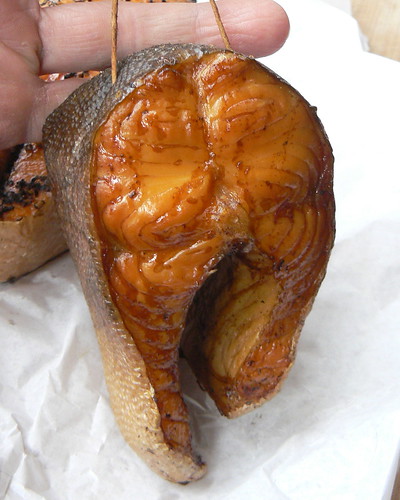
The Accidental Foodie goes to Calumet Fisheries.
Oh boy, I love smoked fish. It's not that hard to make, get some fish, fire up the smoker (really any type of grilling device set on lo) and wait a few hours, Hey Presto, smoky love from the sea. In fact I think it's so easy, that I would never consider buying it. I suppose I have become jaded, I see those golden smoked beauties in the cold case, and I feel like someone is trying to sell me a $20-dollar-a-pound secret that I already know. Well sometimes I'm told to put down my tongs and take a spin on the merry-go-round. And man what a ride.
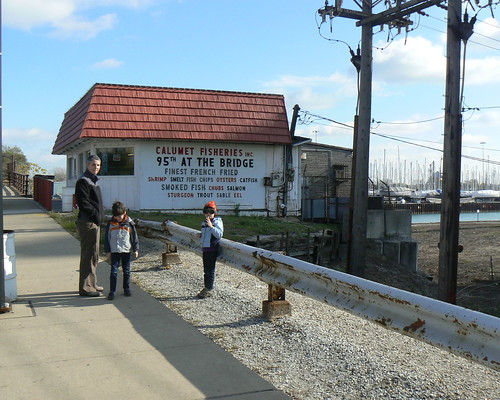
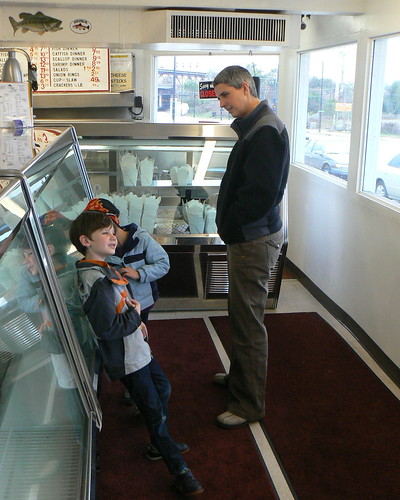
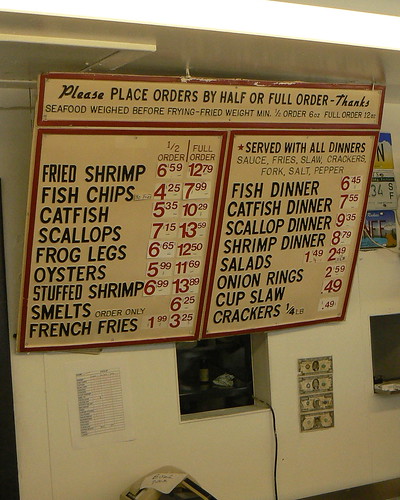
When someone says "fisheries" in Chicago, the person means a place that serves fried fish of some sort in a bag with fries and hot sauce. Calumet Fisheries is a little bit different in that they also offer fish smoked on the premises. We made the trip up to 95th ST, on a bright Sunday morning. We met Carlos who was working the counter and Ray who was tending to the smoker. They weren't too busy so they happily talked to Bonne Femme and me about what they do and showed us the smoker out back.
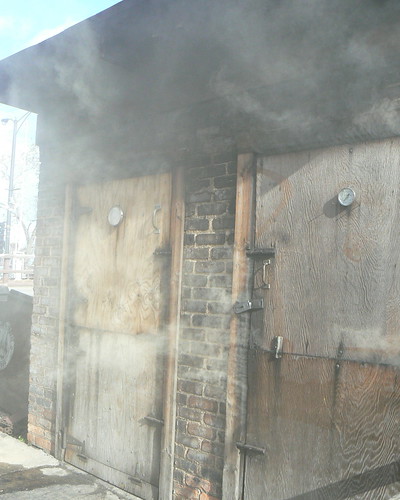
If for no other reason you should visit just to see the brick smokehouse. Perched between the store and the river, it is truly a relic of the past, no electric stainless steel chambers, just bricks, smoke and fish. The fish is hot smoked for about five hours with a mixture of hardwoods. Ray split some wood to give me an idea of the different aromas from the different woods.
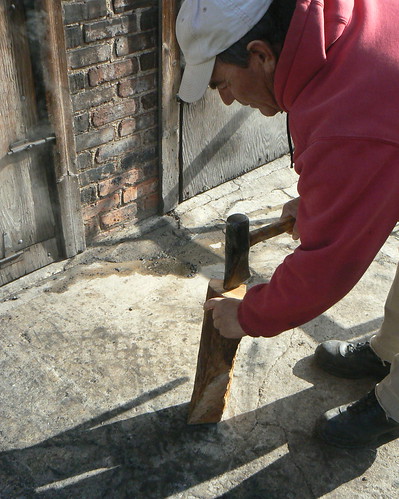
Ray brines the fish before smoking, he said he would be happy to tell me the recipe if had had one, he does it all to taste.
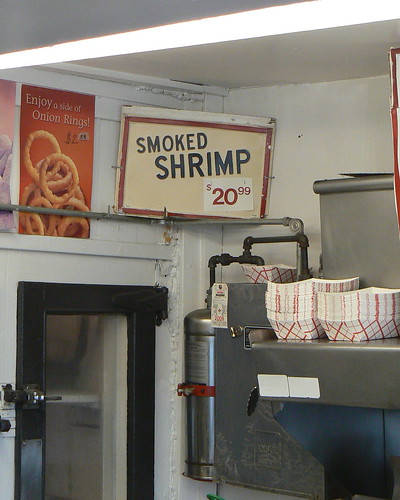
Back inside Carlos offers a sample of the smoked shrimp. Yum. We get to talking, he reveals that he went to culinary school at CHIC, Cooking and Hospitality Institute of Chicago. After getting his certificate he went to work at the casino down the road, but he didn't like it and came back to Calumet. All the school talk started making the boys antsy, Carlos asks me what I would like.
"I dunno what's coming out of the smoker?" Little did I know Bonne Femme was one step ahead of me, outside:

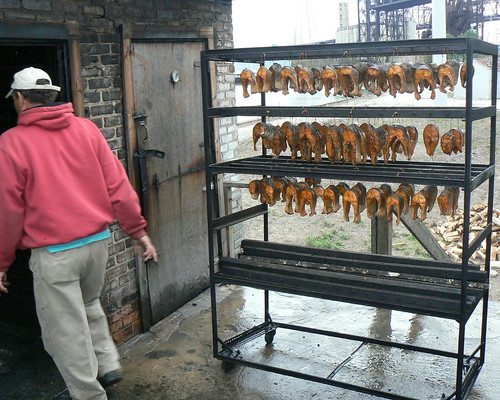
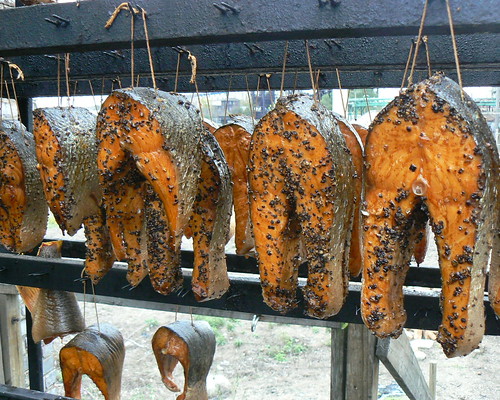
She zeroed in on a piece of trout and a piece of salmon with pepper and garlic.
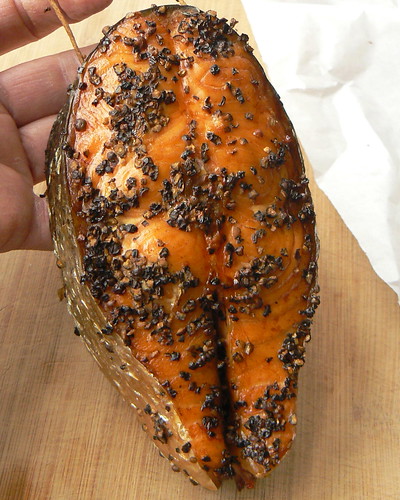
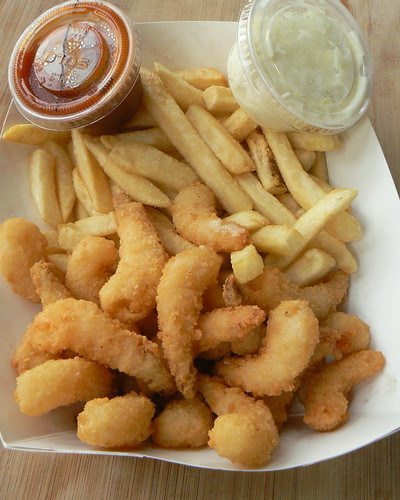
We got a shrimp dinner for the boys, they ate it all. The smoked fish doesn't come as a meal, you have to take it home and make your own magic. Smoked trout rillets maybe?
When You Visit:
While this part of town is remote, it is by no means intimidating. It is more industrial than anything else, on the other side of the bridge is one of Chicago's largest boat yards, Crowley's, they have a very nice ship's store. The bridge spans the Calumet river, not the Chicago. Calumet is also the name of the geologic region that starts roughly at 95th ST and stretches around the bottom of the Lake all the way to Michigan. There's a great book by Kenneth Schoon called Calumet Beginnings, that has a history of the area.
Calumet Fisheries
3259 E 95TH ST
Chicago, IL 60617
773-933-9855
calumetfisheries.com
Parking for Calumet Fisheries is on the street, and there are no tables. They are open 7 days 10am-10pm. Check it out.
Cheers.
09 September, 2008
Belly Time
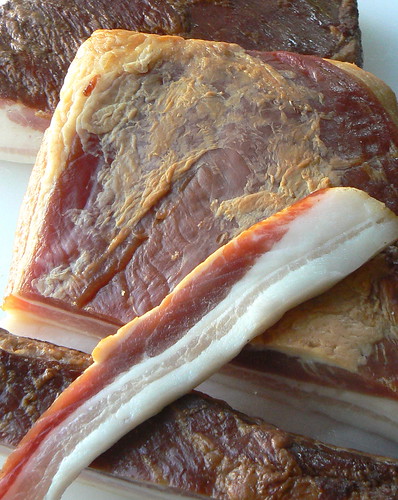
Have you been thinking about making bacon? Now is the perfect time; with the hint of fall in the air, the gentle wisps of hickory smoke should trigger tingling childhood memories like skipping stones on Lake Hope. The late tomatoes are now ripe on the vine. Make up some bread, some mayonnaise, and assemble BLT's. Serve the sandwiches with smoked corn chowder and now you are ready for the season. Maybe a nap first.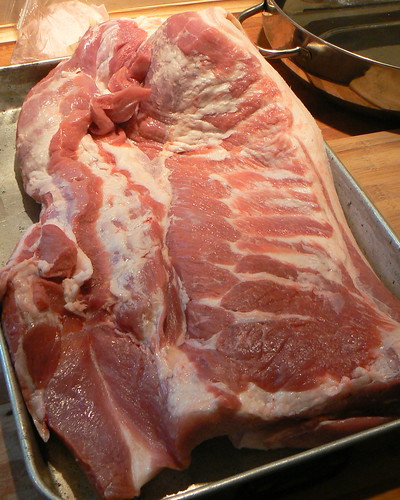
Before any napping there's work to be done. The hardest part of making bacon is finding the belly. Ok, if you live in town nick-named "Hog Butcher to the World," maybe it's not that hard. I get bellies at a meat packer about three miles from my house (say YEAH Southland), the problem is usually the ones in the case are pretty thin, they keep the nice ones in the back to make their own cured love. My friend Brian in New Jersey gets them from a Chinese market with the ribs attached. When searching for your own try to find a place where you can choose your piece, if you don't see one you like, ask if there are any others. Make sure you get a thick belly. If you are at a meat packing operation you'll have to buy a whole belly, they wont cut it, and you're gonna get 12 to 19 pounds of pork. But that's what you want. Get the biggest, thickest belly you can find, because we are not just making bacon, we are stocking the larder.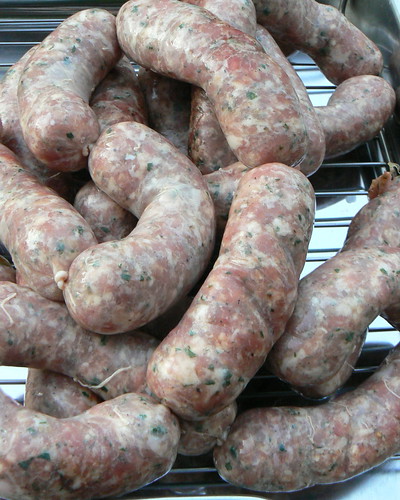
When you get you purchase home you may find one end is really thick with very little fat, and the other end thin and nothing but fat. In addition, an untrimmed pork belly with have fat and meat (a flap of sorts) that sits on top of our future bacon. Now you can simply cut it up into to manageable pieces a cure it, but why not make it look nice?
With my pork side I used the thick, lean portion of the belly and removed the lean flap to make couple of pounds of our house sausage. I used the fatty thin end and any trimmed fat to make lard. I also saved the skin from each of these sections and threw it in the freezer. Skin is useful to thicken soups, Cassoulet, or boiled and diced for a pâté.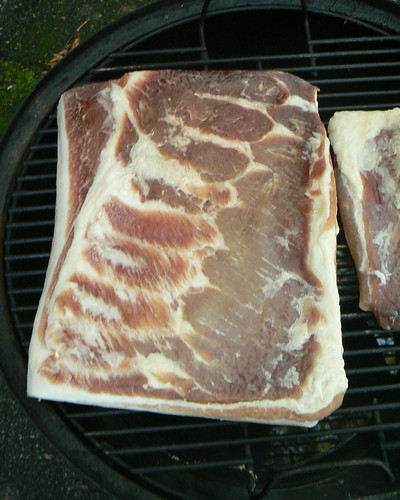
I squared up the future bacon and rubbed it with a mixture of sugar, salt and curing salt. Curing salt is a special order item, I get mine at The Spice House in Chicago. I used the recipe from Charcuterie by Michael Ruhlman and Brian Polcyn, for the dry rub. On a smaller piece I poured on a little maple syrup in addition to the dry rub. The pieces go into ziploc bags and cure in the fridge for five days. In the past I have cured bacon in brine along with ham. I haven't noticed any big difference between the wet and dry cure, except that the wet cure only needs three days.
After the cure was complete, I rinsed off the bacon and let it rest in the fridge of 24 hours uncovered. I actually let it go for two days because I got busy with other stuff but the pork didn't mind.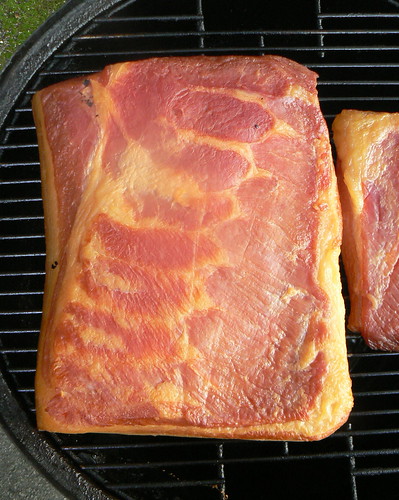
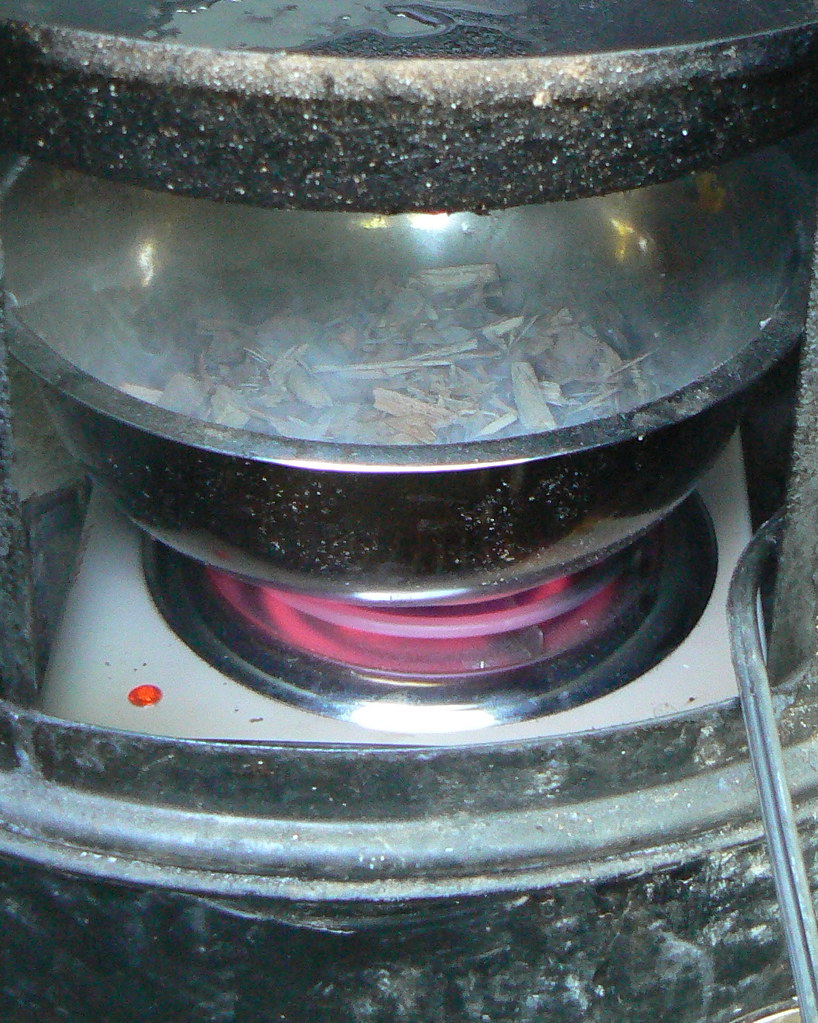
I cold smoked both pieces of the belly for about four hours. The cold smoke rig consisted of a hot plate and stainless steel bowl inside my Bullet. The next day I hot smoked the larger slab for about two hours. While I had the smoker fired up I also threw on some eggplant (smoked baba ganouj) and I hot smoked a few ears of corn (shucked) for the smoky corn chowder. Bonne Femme made the soup.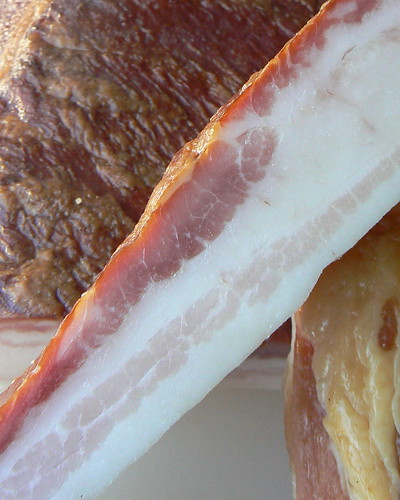
Cold and hot smoked bacon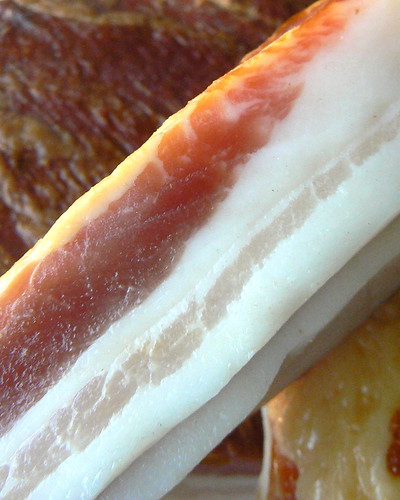
Cold smoked bacon
Either way its a winner.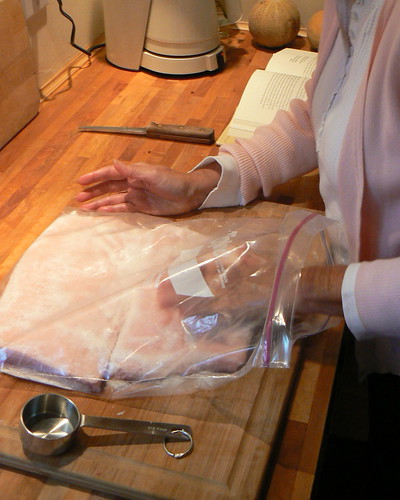
My mom was here last week and she started her own bacon. She took it back to Columbus and she will smoke it on her kettle grill.
Bacon: A pantry staple that's fun for the whole family.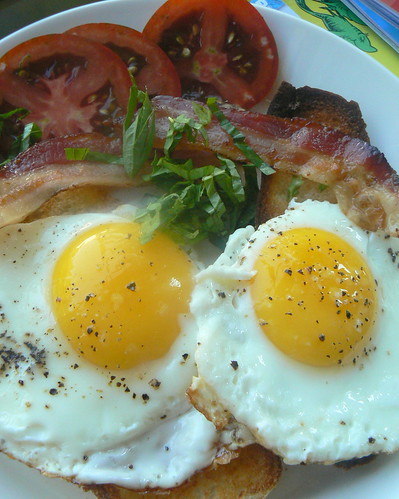
Cheers.
24 April, 2008
Hammin
 Boneless Ham a la Gourmet Magazine 1987.
Here's the scene last Monday about 11:30 PM (that's 23:30 for my Continental friends, and a half hour more if you are in Hyderabad): I walk in with my haul from baking class, 2 rye loaves, 2 pains de campange, 12 mini baguettes. Bonne Femme is sitting on the couch unable to sleep. "I have fresh bread, who wants a ham sandwich?" BF replies, "I would but we don't have any mayonnaise."
"Huh? We got eggs don't we?"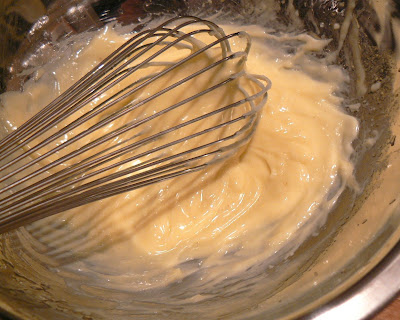
One egg yolk, 1/2t mustard, a splash of vinegar, juice from half of a small lime, salt, white pepper and six ounces of canola oil. Thirty seconds later, Hey Presto, mayonnaise.
Midnight snack.
In school this quarter I am taking a food styling for photography class. Even though a friend who is a noted photography expert remarked, "Take the Class? Hell man, you could teach it," I still need to learn the "Tricks of the trade." I mean how do they get a burger to look hot and juicy even though its no warmer than a jar of jam? How do they make a beer look cold and refreshing even though it's been several hours since it came out of a can? I don't know the answers yet, but I will find out over the next few weeks.
For the first project I decided to shoot ham, so I gotta make some ham. I started with the brine recipe for "Glazed Holiday Ham," from Charcuterie, by Ruhlman and Polcyn. I threw in a handful old pickling spice and boiled it to a tea. Once this mixture had cooled I put in the ham. Since my boneless ham was in several pieces I figured it wouldn't need to sit too long, maybe three days.
Thoroughly pickled, time to tie our friends into roasts.

I let the roasts rest for a day then smoked them on the Weber Smokey Mountain.
Three hours later at an internal temperature of 155F, the ham is ready for its close-up.
This brings me to another philosophical quandary: Food as props. I'm sure somebody has written a book about this but I get an uneasy feeling about "styling" an object in order to made it look appetizing, then throw it away because it's inedible. This isn't a still life, this is portraiture. (all ham depicted in this blog was treated with respect, handled in accordance with sanitary guidelines and happily consumed). I know these thoughts verge on silly, along the lines of stepping on a bug, or the vegetarian having to cook meat at culinary class, I know there is give and take and compromises that are made for the greater good, but I haven't come to terms with it yet; I just can't put it down the drain.
In the mean time here are a couple of pictures of ham doing what it is supposed to do:
(Ham on a bagel under an egg and hollandaise)
(Ham on biscuit with egg)
Feeding someone, making someone happy.
Cheers.