I love Ethiopian food. It's even better when you can make it at home. If you are lucky enough to live in Columbus Ohio, then you have easy access to all the ingredients you need to make a Habesha feast.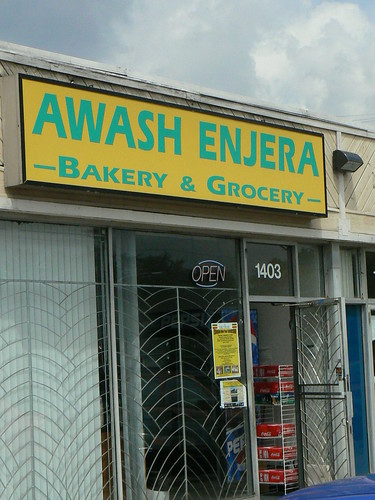
My sister, Finny and I went out to a mini mall on Hamilton, our first stop was Awash Enjera. There we picked up some Barbere, some other spices, and of course enjera. Awash has most everything you need, but if you want to comparison shop you can mosey a few doors down to the Muna International Grocery.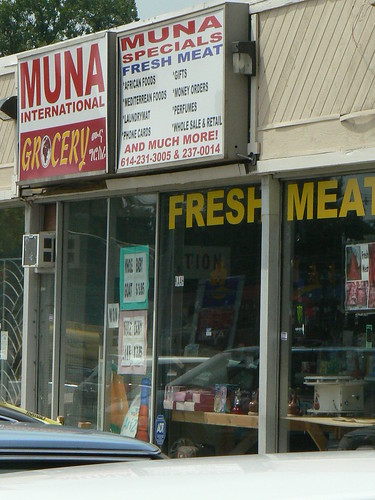
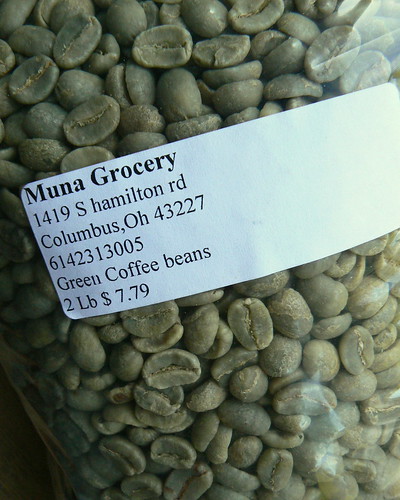
I bought some green coffee beans, I'm gonna try roasting my own.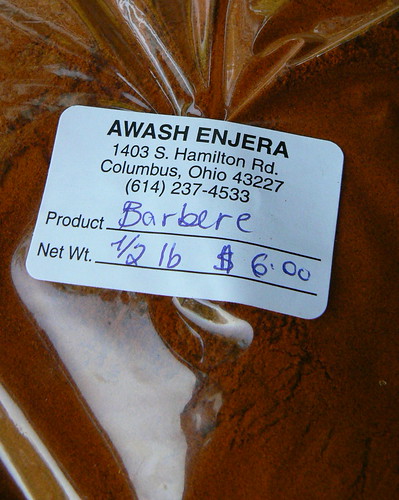
Berbere (I have seen it spelled different ways) is mixture of spices somewhere between chili powder and curry.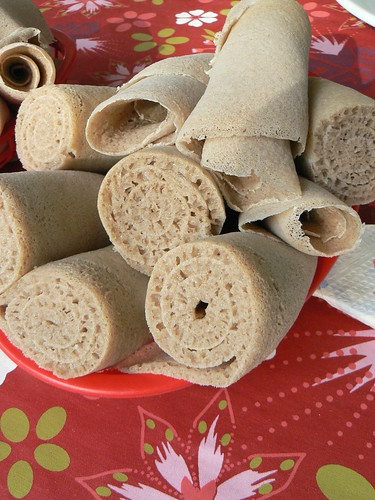
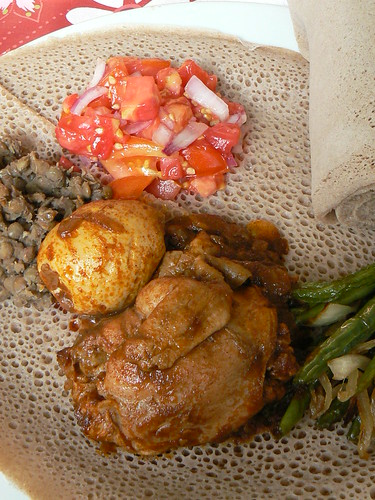
My sister, (Jeanlouise: Jolie) did most of the cooking, she made lentils, Chicken stew (doro wat), green beans, and a tomato salad. everything is pretty easy to make, if you want a recipe, send me a note using the "contact us" button.
Fun food that's easy to make, give it a try.
Cheers.
Awash Enjera
1403 S. Hamilton Rd.
Columbus, OH 43227
614-237-4533
Muna Grocery
1419 S. Hamilton Rd.
Columbus, OH 43227
614-231-3005
PS: Now for some pictures of stuff I don't think you should try at home (yet). Jeanlouise just got back from Ethiopia here's a few shots of what she ate there: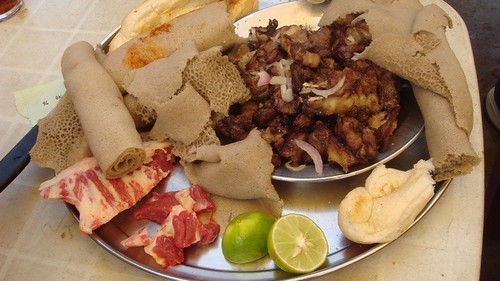
Tibs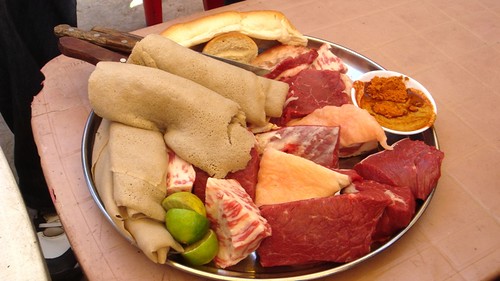
Tere Sega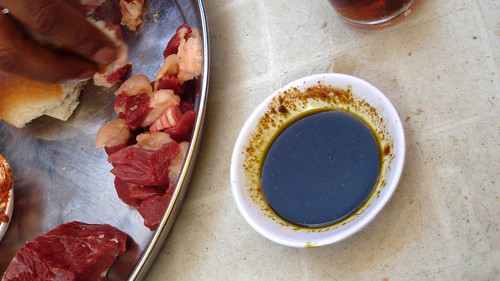
All served with Hamot (Click on picture for translation).
18 August, 2009
Enjera Ohio

14 June, 2009
Mustard Run
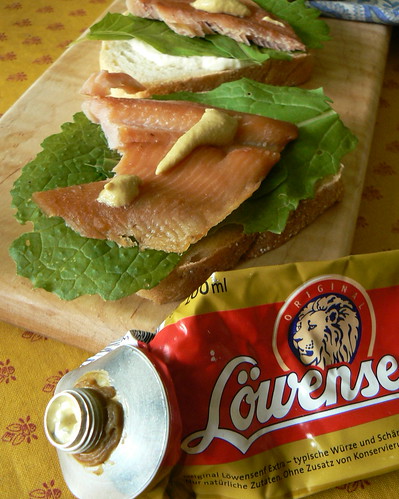
I'm out of mustard.
For our Oktoberfest last fall I asked my brother to send me some. I received six tubes of Löwensenf extra. Needless to say I have become addicted to its strong flavor, it makes Dijon taste like salty paste. I finally squeezed the last bit out of the last tube on some smoked trout. In addition to mustard run(go to the library and pick up The Good Cook's Book of Mustard, by Michele Anna Jordan), my sister(Jolie) just finished her program at Cordon Bleu; so I'm grabbing my chef jacket, some seersucker pants and hoping a flight to the continent. Stay tuned here and on my flickr page for updates.
Cheers.
20 April, 2009
The Paris Beat: Le Boudin Noir
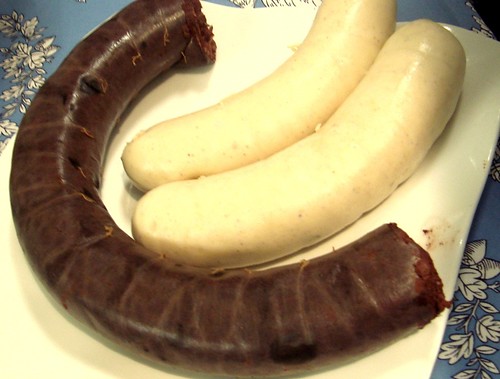
The Paris Beat is covered by our foreign correspondent Jeanlouise: Jolie
[Dear Macmac]
Here’s an oldie but goodie for the nose to tail crowd: Blood sausage, or as my French friends say, le boudin noir. Blood is pretty high up there on the squeamish scale, but with rich flavors and no funky textures, the adventurous will be rewarded for diving in mouth first. I bought my first blood sausage in March when hosting some traveling eaters from Ann Arbor. When we approached the counter, I only knew we wanted boudin noir. A piece was cut off and wrapped in paper. I asked for guidance on preparation: It was already cooked so it could be eaten cold or even better if you have the time, fry the sausage gently in butter and serve up with some cooked apples. After picking up some apples from the fruit vendor next door, we excitedly headed home and got the frying pan going. I was a bit nervous about trying the sausage. I mean, blood man, gross right? Wrong. After chomping up that sausage, I sat back reassured, satisfied and curious- what was that thing and why was it so tasty?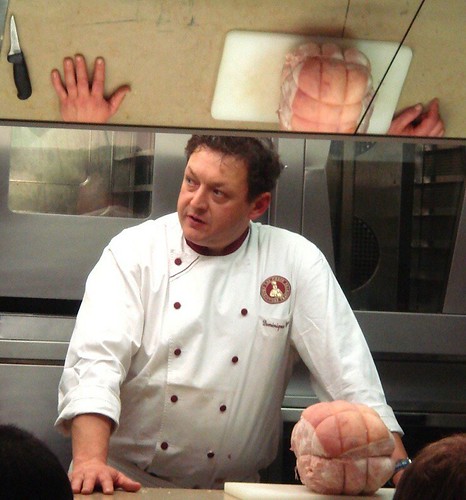
Answers came last week when master artisanal charcutier Dominique Bignon came to school for a demonstration. Monsieur Bignon has won many awards for his work including the gold medal for boudin noir in 2006 (another reason to love France: it is a country that rewards good work). He runs a shop called Au Cochon Rose (The Pink Pig) in the XVeme. He has about 10 full time workers in an on-site ‘laboratory’ where they make blood sausage every Tuesday and Friday, among many other things (terrines, pates, head cheeses, hams, rilletes, etc). 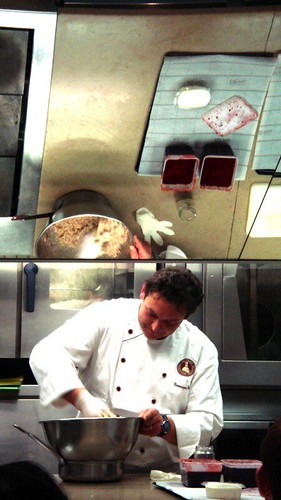
Monsieur Bignon’s smiley demeanor won me over immediately- here was a man who loved the pig. He set to work demonstrating how to make boudin noir. The ingredients are simple: equal part of onions, jowl and blood, some cream, parsley and seasonings. The onions are chopped and cooked into a confit (softened and sweet). Then the jowl is added and cooked very gently-- or lovingly according to M. Bignon! for about 10-15 minutes, at which time the parsley is added. 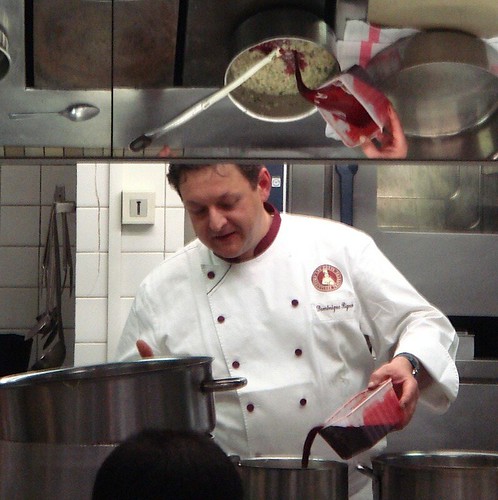
Then, then magic happens . . . .off heat, the blood is poured into the onions. Spices (salt, pepper, nutmeg and the royal boudin spice mix) are stirred in followed by the cream, which acts as a biding agent. 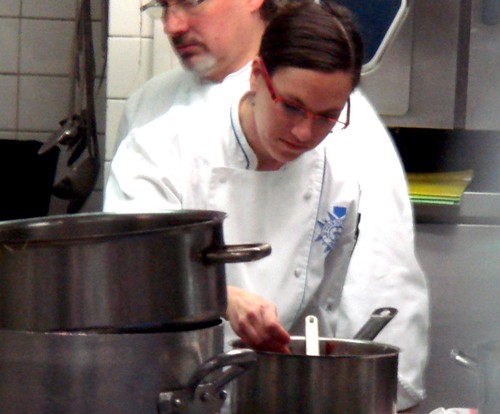
At this point, he asked if anyone wanted to try the ‘raw’ blood mixture. My hand shot up. Jokes about me being a pastry student were made. The stuffing was delicious and ready to be funneled into casings. Purists will stop here. But if you wish, you could at this point add to the stuffing cooked apples, chopped chestnuts, fatback, cabbage or what ever else you dream up. . . 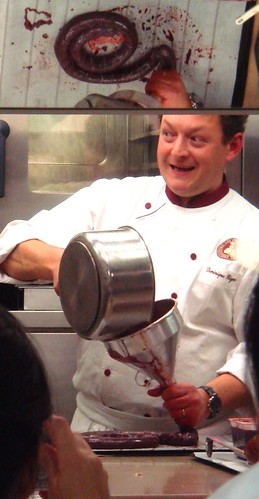
Our master charcuiter used a large metal funnel to stuff the casings. He did not knot the end to avoid air pockets, and tied off both ends once the casing was filled. 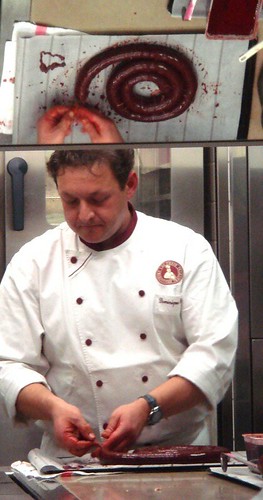
The tying he said, was the trickiest part. Anyone who has made sausage will agree. You walk the fine line between a nice plump link, and the alternative, a burst casing and blood all over your kitchen (Brown dogs will however, lap up your misfortune). 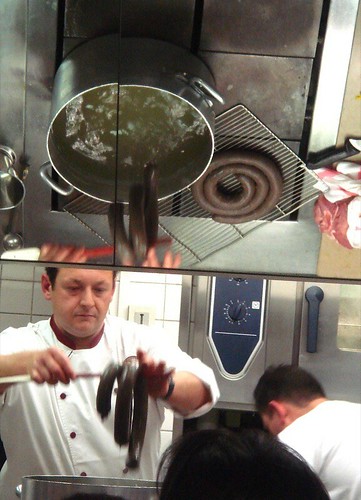
To finish off, the sausage is poached (80 c) for 15-20 min (or until it does not geyser out when pricked). The poaching water should be green, as this is an indicator of fresh blood with the principle being that the greener the water, the fresher the blood.
The freshly poached boudin was delicious, homey and incredibly rich. There were also other preparations from the Cochon Rose for us to try (a variety of head cheeses, ham, duck liver pate). The one dish that really blew me away was a variation on the boudin noir: a boudin noir terrine. 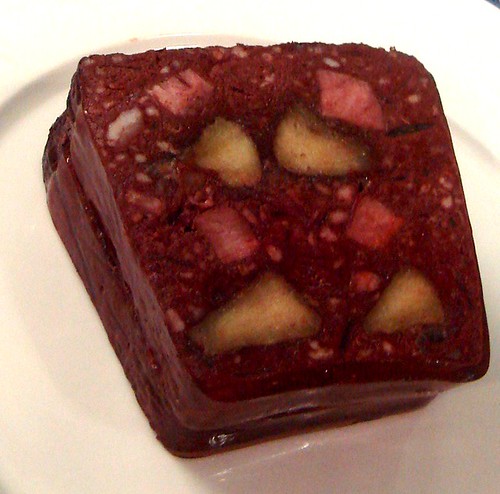
The terrine is made from packing the base boudin noir stuffing into a greased loaf pan. In order to have a firm, sliceable loaf an additional gelling agent is required. Pig snout is the part of the animal that contains the most gelatin (feet are second). To prepare his terrines, M. Bignon will pre-cook fresh (not brined) snouts, chop them very fine and add them to base. A terrine will need to cook longer—about 1 hour in a water bath in a gentle oven. The internal temperature should reach 72 c, 65c being the magic temperature at which proteins bind properly for a nice solid terrine. The terrine that I tasted also contained pig tongue and cooked apples. Again, I was nervous. . . I mean tongue, gross right? Wrong again, so very wrong.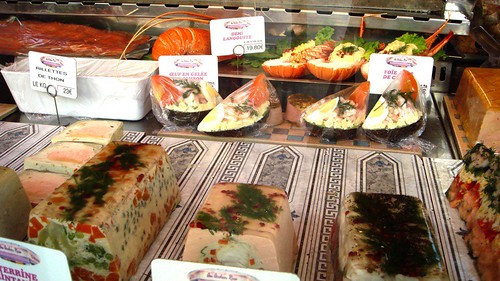
Très Bien!
Au Cochon Rose
137 RUE SAINT CHARLES
75015 PARIS
01 45 78 03 68
DU MARDI AU VENDREDI DE 9H00 A 13H30
ET DE 15H30 A 19H30
SAMEDI 8H30 A 19H30
DIMANCHE DE 8H30 A 13H00
08 April, 2009


20 March, 2009
The Paris Beat: Spring Break in Alsace

The Paris Beat is covered by our international corespondent Jeanlouise:Jolie. Currently She's in Paris working her way through the baking and pastry program at Le Cordon Bleu. This week is Spring break and she traveled to the Alsace region to report on doughnuts gone wild.
Hi macs, you would luv this place- Alsace is pork heaven.
Last week, I took my final exam in the intermediate pastry program. It was a real stinker of an exam, but I passed at least. I had to prepare a cake given only an ingredients list, 2.5 hours and a chef breathing down my neck. Well, after that it was spring break, and with Cancun outta reach, me and a pal opted instead to spend a week exploring the scene in Alsace. 
Alsace is located in the north-eastern corner of France. This tiny region is separated from neighboring Germany by the Rhine and from the rest of France by the Vosges mountains to the west. It is a unique area with its own Germanic language, culture, and mostly Lutheran religion.
I was attracted to Alsace because of its wines: principally white and ranging from refreshingly dry and mineral to late harvest sweet wines. I am now in love with Rieslings (the nice minerally dry ones in particular). All the other stuff is pretty good as well. Something for everyone, right? Because wines in Alsace are identified by grape rather than geography, they were much easier for me to get a handle on. A Pinot Blanc is a Pinot Blanc, Muscat is Muscat, etc. It’s a grand cru if it’s grown in a field identified as producing superior grapes. That’s the about it when it comes to the basics. I’ve come to appreciate more and more (thanks to France . . .) that wine is best with food and food best with wine. So I had to pleasure of digging into not only the wine, but also the food that it goes best with-- the food of Alsace! Here’s what’s for the chomping in Alsace. . . . .
Alsatian Sauerkraut(Choucroute): A mound of sauerkraut topped with a variety of porcine delights including belly, ceverlas, blood sausage, frankfurters, ham, pork knuckle. . . ). It was awesome, and my major splurge in the meals department. I kept thinking, Jolie, you should eat more belly, that is where the flavor is. Also blood sausage, super rich and delicious, I should eat more of that. The wine pairing that works best with this pork fest is a Riesling or a Sylvaner (I had a nice grand cru Riesling).
Onion Tart: Not quite dessert, but not totally savory, one thing this pie definitely is is delicious . . . throw in a nice green salad and a glass of Sylvaner and you got some serious plans. The simple prep to deliciousness ratio is definitely in the cook’s favor.
Flammekueche: This is essentially a flour tortilla type crust topped with crème fraiche, onions and bacon. There are other variations, but this is the basic recipe. Here is what I want to know: hows come this thing tastes so good? Is it the crème fraiche? Is it the bacon? I tried it with beer and I had it with Riesling. Both were great, so do what feels right.
Snails: Snails are delicious. I recommend if you haven’t tried them, just do it. You know who you are. Seriously, don’t think about your garden, just chomp. I haven’t seen these things for sale in the market, which seems curious, but I would be very interested in trying them at home. Supposedly the cooking process is long (several hours). I guess that means it takes a while to get the slime outta them slugs. Wait, you’re not supposed to be thinking about that part! Pop a bottle of Alsatian Riesling to help you forget . . .
Kougelhpf: This is the emblematic pastry of Alsace and these things are everywhere. It’s got all the good looks of a bundt cake and all the nail biting excitement of a coffee cake. I’m saving my chomping for something more yumm-o, as the feller says. The ‘vendage tardives’ or late harvest wines tend to be quite sweet because they are left on the vine and infected with noble rot (a friendly fungus that concentrates the juices in the grape by removing water from the fruit). These wines are great for pairing with fruit tarts and other sweets though the traditional pairing for kouglehopf is a glass of gewürztraminer.
Munster cheese: Ok, I thought I knew what Munster cheese. Its white, got that reddish rind and is chewy and mild? Well maybe at the Kroger, but in Alsace Munster is hard-core in your face. It is a goopy, washed rind stinker of a cheese. I went to the village of Munster, found a local cheese monger and picked up 350 grams of the stuff.
The dude says, lady, this cheese has real attitude. I was all like, kewl, I'm all into attitude; I'm a wild and crazy guy, quoi. Well, I had no idea what I was getting into. 
That cheese is crazed like a coon hound, it's cute at first, but you get into your third or fourth helping of the thing and you’re like, wait, you’re not cute anymore, you’re just insane. Well, thankfully the Munster didn’t dig through my purse and chew up my cell phone, eat Jo’s glasses or jump out of a moving car, but wow, I don’t know if I’ll have that again for a while.
Pair with Gewurztraminer, the only wine gutsy enough to stand up to that stuff. Hey, daredevils: try it. You might like it. If not, at least you’ll have more hair on your chest. Now to find le nair. . .


Donuts, donuts, donuts. Like any good girl from Columbus, I luvs me my donuts. Imagine my delight to find like-minded people in Alsace after spending so much time in the donut desert of Paris! Donuts done right and filled with jelly, pudding, or shaped into pretzels and coated with sugar abound. 
Yeah, all that and I even chomped a real live apple fritter. I kept thinking maple logs would go over real well here. The Alsatian donuts (or beignets as they are called locally) are serious, confident and satisfying. I paired them with coffee and got off to a great start each and every day. . . .
I’ve got recipes for everything except the donuts if you is interested. I really encourage you to get up to your local wine dude see what they have in the way of Alsatian wines because they are a delight! I am also trying to convince the director at the Clintonville Compound to plant some vines on the front hill- bonne idea, non?
More from Paris soon.
JL
15 February, 2009
30 January, 2009
13 January, 2009
The Paris Beat: Christmas and Croissant Lesson
 Buche de Noel in County Waterford
Dear Macmac:
First of all, happy new years to you. I hope that you had a great holidays and enjoyed your time slaving over the smoker for the relatives. I myself had a great time. . .especially cooking with the crew in a real life sized kitchen. We whipped up several batches of pain raisin, pain au chocolat, ham & cheese croissants and a buche de noel complete with very real looking Italian meringue mushrooms!
I think I am now at the point where I feel like croissants are in the bag. It’s no longer a serious production to put them together and a little advance planning makes things really simple. So what has caused this? Besides plenty of practice, two pieces of information thanks to my fantastic chefs at cordon bleu. Firstly, the detrempe (or initial dough mass) does not, should not in fact, be kneaded. Oh, if only I had known this before I broke mom’s kitchenaid while working up dough for croissants. Ok, so all you do is dump everything together in a bowl and stir it up so that everything in well combined (the flour, yeast (instant or fresh), sugar, salt, water). Let this marinate overnight in the fridge. C’est ca. The kneading is not necessary because you are going to be giving the dough enough of a workout as you do your turns (or folding). Which brings me to my second major lesson: croissants only need three simple turns. In my pre-cordon bleu days, I always did six. This is what Dionne Lucas recommended, so I thought it must be. As it turns out, three is enough (but puff still wants six, ok!). So when it comes to folding in the butter, you do two simple turns, chill 15 min, then one final turn, cut, shape, rise and bake. Or if you have the time, let the dough rest overnight. I’ve gotten much better flavors this way. We have these real fancy proofing machines at school set at ideal rising conditions. Well, when these were full, chef put our croissants in a very low oven for a rise. And it works: instead of taking 2 hours, I get properly risen croissants in less than 30 min. Careful though, if the oven is too warm, the butter will leak out and that is no good. An oven temp of around 90 f or 50 c is ideal for rising. Oh, do I have one more pearl: egg wash. Two coats is the best, with one coat done before rising and another done just before they go into the oven. Best looking croissants you ever saw, deep golden brown beauties.

Now what! Pain aux raisins is a very yummy, easy thing to do with croissant dough. Roll out a rectangle of dough, maybe 12x20 inches. Arrange the dough so that the short side is facing you. Roll out one short end so thing it is basically smashed on to the counter (super thin). Spread a thin layer of pastry cream over the top 5/8ths of the rectangle. Sprinkle with raisins. Brush the smashed short side with a bit of water or egg wash (this will be the glue for the roll), and roll the dough up into a log. Cut off ½ inch slices and place them on a baking sheet. Let rise until doubled then bake until golden brown. Brush with a simple sugar syrup as soon as they come out of the oven and you will get a very nice shiny finish. Not that you will have too much time to look at them, especially if there are any Eliots or Christophers in your general vicinity.
Croissant dough:
1kg AP flour
25g salt
150g sugar
30g fresh yeast (or 12g instant yeast)
550 ml water (more or less depending on the season and the flour)
600g butter for the turns
Soon,
jl
24 November, 2008
The Paris Beat: Fruit Cakes

The Paris Beat is a new feature on Saucisson MAC. Follow Jolie, (my sister) as she has adventures living in Paris and attending Culnary School. This is her second postacard.
So I’ve been busy baking all week. It’s been great. So far we’ve made some very unexciting stuff, nice and easy for the first week! Shortbread cookies, fruit cake, madelines, apple tart. Tomorrow we are making gateau basque which is fancy talk for a butter cake with a layer of pastry cream and some prunes baked in. The very worst part is, we take everything that we bake home. This means I’ve got 2 fruit cakes, 16 madelines, who knows how many shortbread cookies and an apple tart sitting on the kitchen counter. This problem is going to be compounding. An advanced student was trying to unload a chocolate pistachio cake last night and I had to look at her like she was nuts.
Hope you are doing well. I will send more pics and stories soon!
Bis,
jl
13 November, 2008
The Paris Beat: Getting Started
The Paris Beat is a new feature on Saucisson MAC. Follow Jolie as she has adventures living in Paris and attending Culnary School. This is her first postacard.
I need to take more pictures, but I wanted to send you this one with the cool hat you gave me. I think it is one of a kind in Paris, where people are more stylish than in DC, but dress out of the same color palate.
There is a picture of a coffee at café Delmas where a coffee with cream costs 5.20 euros because Hemmingway used to live on the same street. Wonder what he would think of that.
There is a picture of the Seine,
and finally a shot my window in what my landlord describes as ‘a great view of the rooftops of Paris’. I will get to snapping more.. . .school starts next Monday!
Soon,
jl
29 October, 2008
Chile Time

We had our first freeze in the Chicagoland area yesterday, so I brought in the last of the peppers. I'll hang these somewhere to dry. For the last month I have been real busy with school and travelling, I did manage to make some Italian style chicken sausage yesterday, but no time for blogging. Jolie is off to Paris today to embark on her Baking and Pastry odyssey, she has promised to send postcards.
A couple of weeks ago we were in Columbus where we smoked trout and made Ethiopian Food. We got enjerea from a bakery on the east side. Check out the pictures on flickr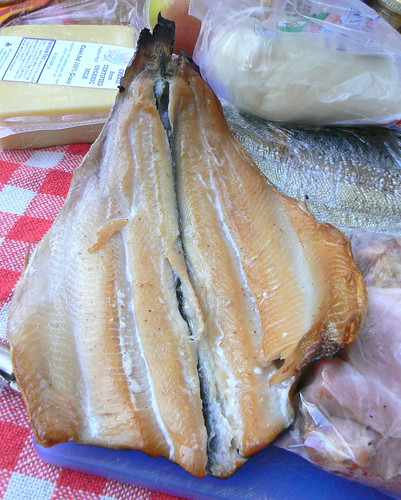
Cheers.
16 April, 2008
The Istanbul Report: Food in The Streets
 Grilled mackerel on the Galata bridge
"You and Ledina can eat all that crap together in Turkey."
--Eric (Ledina's husband) on prospects of eating non-fleshy animal parts.
I had no idea what I was getting myself into when I decided to visit Istanbul. I was going to meet up with Ledina, a good friend of mine from the Addis Ababa salad days. Ledina is a most impressive gourmet adventurer and I knew that she was the perfect person to discover a new world of culinary delights: After all she was the first one who dug in to the raw goat chunks (Tere sega), when we were in Ethiopia. We were joining Ledina’s sister Bora her friend Michael. It was a small army of fearless eaters-- stuffing our faces as we worked our way forwards and backwards across Istanbul, stopping for the occasional draw on the nargile or water pipe. The four of us were primarily interested in street food, as it tends to be the best tasting, cheapest and lets say, experiential. This is the way to locals eat anyways, not in tricked out tourist traps of ‘we have terrace’ restaurants with menus in four languages. Sultan’s Revenge be damned-- I’d rather eat hunkered down on a street curb swatting off the battalions of stray cats (and there are A LOT of stray cats in Istanbul!) than in a restaurant. 
I had purchased a Lonely Planet guide that included a run down on street vendors and things that we might come across such as mussels, fish sandwiches, cucumbers, raw meat balls, etc. It warned that sampling some of these dishes risked bouts of severe diarrhea. The stuffed mussels for example, were recommended only for those that wanted to live ‘very very dangerously’ and went on to add ‘if you try these, you must be mad’. I wanted to live dangerously. And yes, I might exhibit symptoms of madness; but having lived in sub-Saharan Africa in a mud hut drinking river water for two years, I figured I already played host to most of the possible range of microorganisms and furthermore believed that the Turkish varieties were probably pretty small time stuff compared to their African counterparts. I was not to be proven wrong.
I sampled all that I could off the streets. The stuffed mussels for those who live dangerously? they were OK, but tasted more like a ball of rice than of any shellfish. There was amazingly delicious rice pilaf, with such fierce turnover, it is highly unlikely that it sat anywhere long enough to be fertile ground for bacteria.

The grilled fish sandwiches were always good, made more fun by the novelty of ordering them off of tiny wooden fishing boats docked along the Golden Horn river. Unfortunately, I never did manage to get my hands on the raw meat balls. Given my love of kitfo, it looked like they would be right up my alley. We hit everything else on the lonely planet list though, and more. I loved the carts of raw cumbers, expertly peeled before your eyes and served with a shake of salt.

Thirsty? There were carts laden with fresh oranges and grapefruits, pushed by men who would slice open and juice up some refreshing citrus. I was most enamored with kokorec, which are sheep’s intestines.

I used to be a bit squeamish when it came to the interior meats, but now-a-days I have a true appreciation of their capabilities. Especially when prepared porchetta style, all tied up and seasoned with aromatic herbs and served in a hot roll. I am ready and waiting for Macmac to try his hand at some boudin or haggis.

It wasn't all fish sandwiches and barbecued sheep intestines for us though, the sweet stuff is just as good and just as plentiful. Pastry and candy shops selling lokum (gummy Turkish candy) and all manner of baklava dot the city like the syrupy sugary stars. We also became specialists in the wonderfully eclectic asure.

Asure is a mix of fruit, nuts, grains and beans in a sweet starchy medium perfumed with rose water and cinnamon. Asure has it all, texture, flavor, color and all around mind-belly satisfaction--it feels good to eat it. The rosewater aroma imparts asure with a very sexy, exotic attitude, emboldened by dried figs and pomegranate, but is grounded in homey familiarity with its broad white beans, chickpeas and barley. We tried one that even contained maize kernels! I will certainly begin trying my hand at recreating this in my mother’s kitchen in the coming weeks... Asure is also interesting to me in that it breaks many of the rules that have been laid out for desserts in the western context. It is not cakey, flaky, creamy or chocolately; it isn't even terribly gooey. Often times, we just ate asure for lunch rather than downing a greasy French-fry-lamb kebab. Of course, we also took a fish sandwich for dessert.

Thanks Jolie. I believe my sister is getting back to the US today. You'll need to book her quickly for your Turkish-Ethiopian party food, she doesn't stay still for long.
Check Jolie's Flickr Page for more photos.
Cheers.