30 June, 2010
30 April, 2008
Spring, I hardly know you.
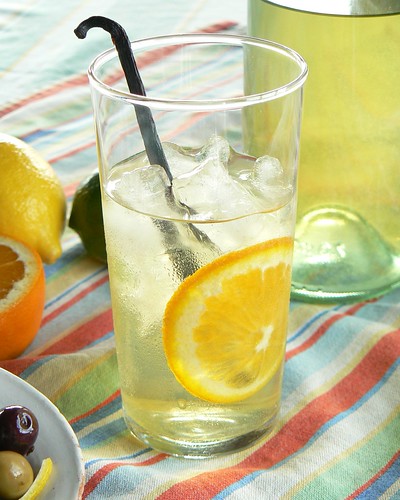
So much for April. Last week in photo styling class we had to shoot a beverage and convey temperature. Does it look cold? The condensation portrayed here is a 50% glycerin mix. So much for the magic.
What's more important is what's inside: Homemade fortified wine, vin de citron, commonly referred to as vin de hoo-hoo. This year why not make a batch? Impress your friends with homemade Lillet. Summer is right around the corner.
Here's a link to a previous post on making vin de citron
cheers.

19 July, 2007
Mid-Summer Madness

However since our good friends from New Jersey were in town we took the opportunity to spin again some of the house favorites.
 With a few things from the potager, I recreated the Chicken Liver Sausage, which we enjoyed for an appetizer.
We followed that with another edition of the mini-porchetta, this time instead of using pork shoulder, I wrapped a boneless loin with the pork belly.


To accompany the rôti de porc, La Bonne Femme, ripped a receipe from Gourmet, May 2007, for Aligot with Horseradish cream.


(ah-LEE-go) uh-huh.
For dessert mint ice cream on cornmeal sugar cookies (Gourmet, July 2007).


And we ended the evening as we began it: En pleine air avec trop de vin de citron et menthe.
Cheers.
26 March, 2007
Put a Cork in It


Once you are ready to get started, put some corks on to simmer. You don't really want to boil them hard, but simmer in a covered pan and they should be soft enough to work in 15 minutes.
 Pour the contents through a strainer, or colander, into a large pot. Next transfer part of the batch to another receptacle, like a 3 litre measure, straining it with a fine mesh strainer(Sorry no picture).
 Now measure out 750 ML to another measure, straining it through the fine mesh strainer lined with several layers of cheese cloth. Take a clean wine bottle and sterilize it by filing with boiling water. Empty the water and funnel in some vin de goodness. Repeat until you have about six bottles.
Put a cork in it.
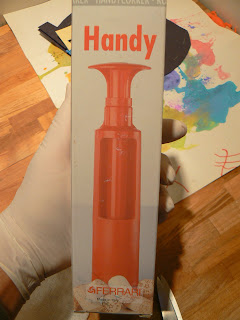
Yer gonna need something to get the cork where it's supposed to be. I got this thing, called Handy Corker, which fits the bill, for less than 10 bucks.

One of our faithful readers phoned in last week saying: Gee MAC, I see all the talk about vin de hoo-hoo, but I don't see a recipe. Well here you go. The original recipe I adapted from an article titled "Nibbles and Sips," by Mona Talbot, Published in the New York Times Style Magazine, Fall Living, 2004.
Vin de Pamplemousse
3 ruby grapefruit
3 white Grapefruit
4 lemons
5 bottles (750ml) of white wine
1 bottle (750ml) vodka
2 cups sugar
1 vanilla bean split
Thinly slice fruit and combine with all other ingredients in a 2.5 gallon glass jar. Stir to dissolve sugar. Store in cool dark place for forty days. Bottle as directed above. Serve over ice.
I got my glass jar at the Container Store. I put a bit of plastic wrap over the opening before screwing on the top.
For corks and stuff (and a container for that matter) try to find the local beer/wine makers shop. In Columbus, I think my mom got set up at The Winemakers Shop. I loaded up at Bev-Art in Beverly.
You don't have to spend a whole lot of money to do this. Once we started doing it we got hooked. We have used all different kinds of wines and all different kinds of citrus, my favorite is probably the Meyer lemon. Find out what you like by experimenting. Vin de hoo-hoo is easy to make and it is fun to drink.

Cheers.
28 January, 2007
Vin de Citron Meyer
 Vin de citron meyer et moro
A quick scan of a few blogs this week reminded me that it is Meyer lemon season. Yesterday we made the trek up to Whole Foods to pick a few up at $3.99/lb. Our preparation here is a fortified wine which I detailed last year in the posts Vin d'Orange and Vin de pamplemousse. The first time I made this stuff I figured I would made one batch and that would last the summer. However, ended up making at least five batches last year and this is our second batch for this year. It is really easy to do, and not too expensive (we used Sauvingion Blanc from Trader Joe's), so get started and impress your friends with your own cool summertime drink.
Cheers.
22 September, 2006
Building a Cold Smoker: The summer sausage episode part 2

Dear Gentle Readers:
Sorry I have not updated you sooner. Didn't realize the summer sausage would become such a cliffhanger; a regular who shot J.R., huh? For all of you writing in clamoring for closure, I'll give you the short answer so that you can get back to work translating German or whatever it is you do between instant messages, everything turned out very nice. As for the long answer, well....
If August is the Fairest of Months, then September (October too) is the shank of the year. It is the beginning of the season for the art world, school, tv and, oh yes, OSU football. The garden is still plump with tomatoes, squash and eggplant, but the weather is starting to nip. It is simply a beautiful time I feel best enjoyed by sitting around a table with friends and family enjoying something good. To that end I have been cooking like crazy and I have a bunch of episodes ready to go. Future updates may include: Chorizo in the morning, My First Pate, Bacon Madness, and Jerry's Kielbasa. But as we are here on the last day of summer let's finish what we started.
The summer sausage episode part duex.
So we left off last time with sausages hanging to dry in the refrigerator. The recipe called for ten hours or drying, it ended up being two days. So after a couple of days I finally had time to set up the cold smoker.
3. The Rig
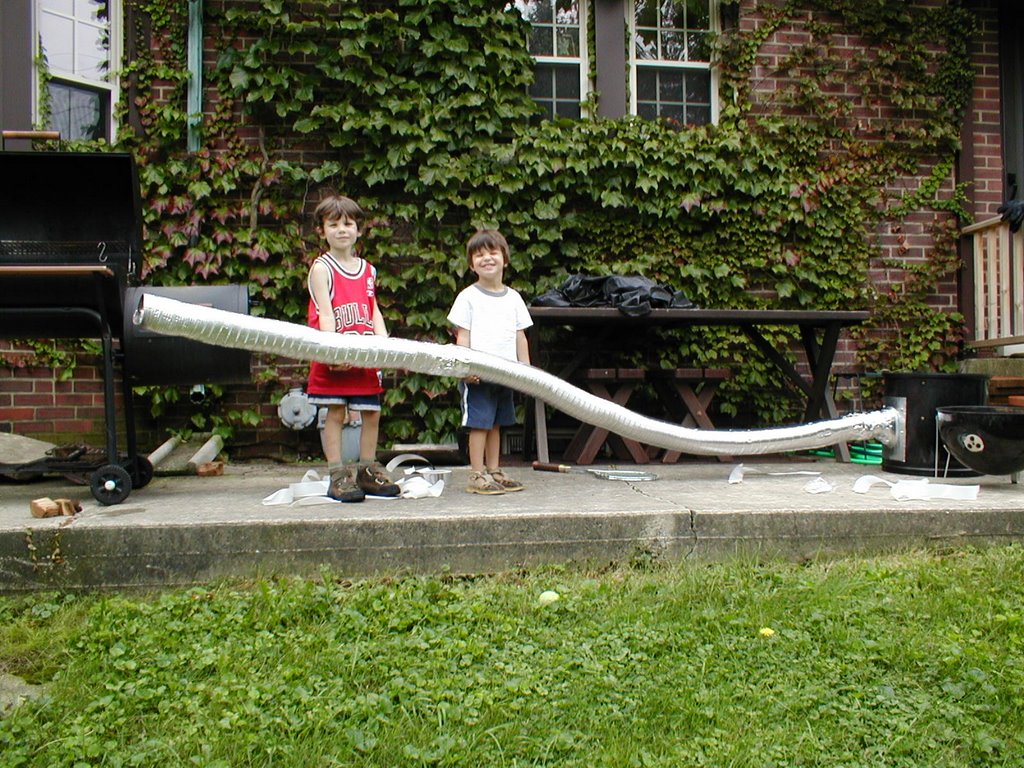
I didn't do a whole lot of research on this design, I needed to get the smoke out of my Weber smoker and into my other grill and reduce the smoke temp to under 100F. Me and the boys made a trip to Menard's.

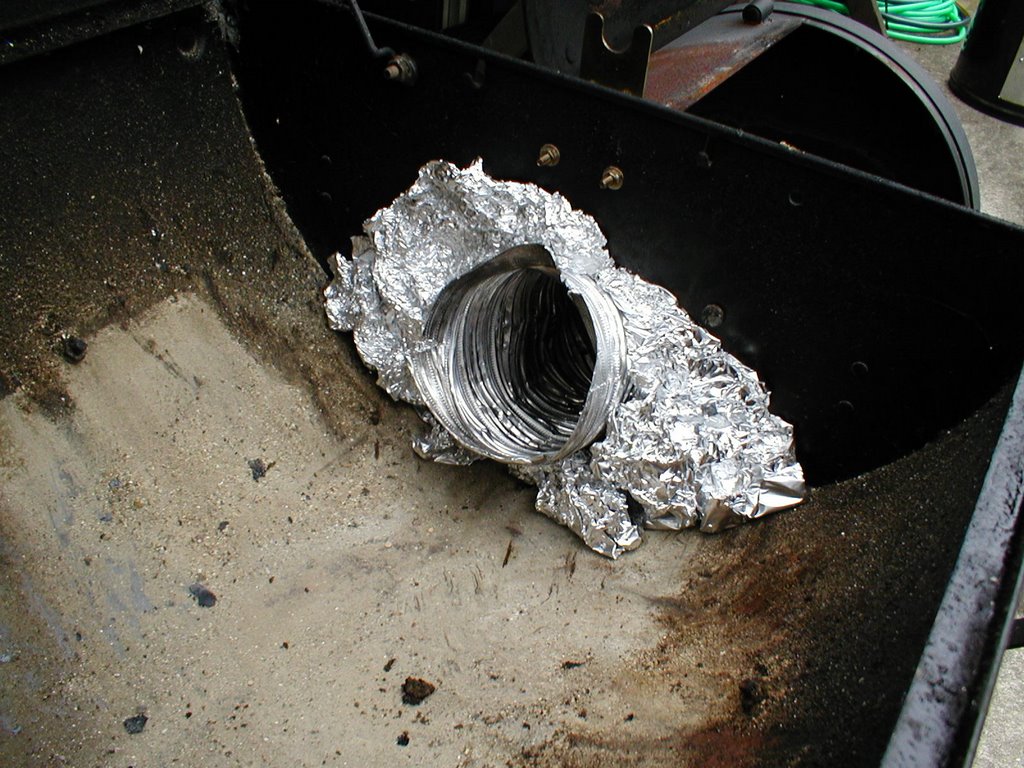
We picked up a galvanized roof vent thingy and some aluminum dryer vent. I fashioned the roof vent to fit into the fire door access on the smoker. I secured it with toggle bolts. 

 Next I attached the dryer vent tubing. I first tried foil tape, but learned quickly that the adhesive fails at temperature. Some drywall screws solved that problem. Time to get the rig smokin.


4. The smoke
The cold smoke temperature stayed around 90F. I let it go about 4 hours then I hot smoked the sausages to an internal temp of 150F. To raise the temp I simply moved the meat. The hot smoking took about an hour.

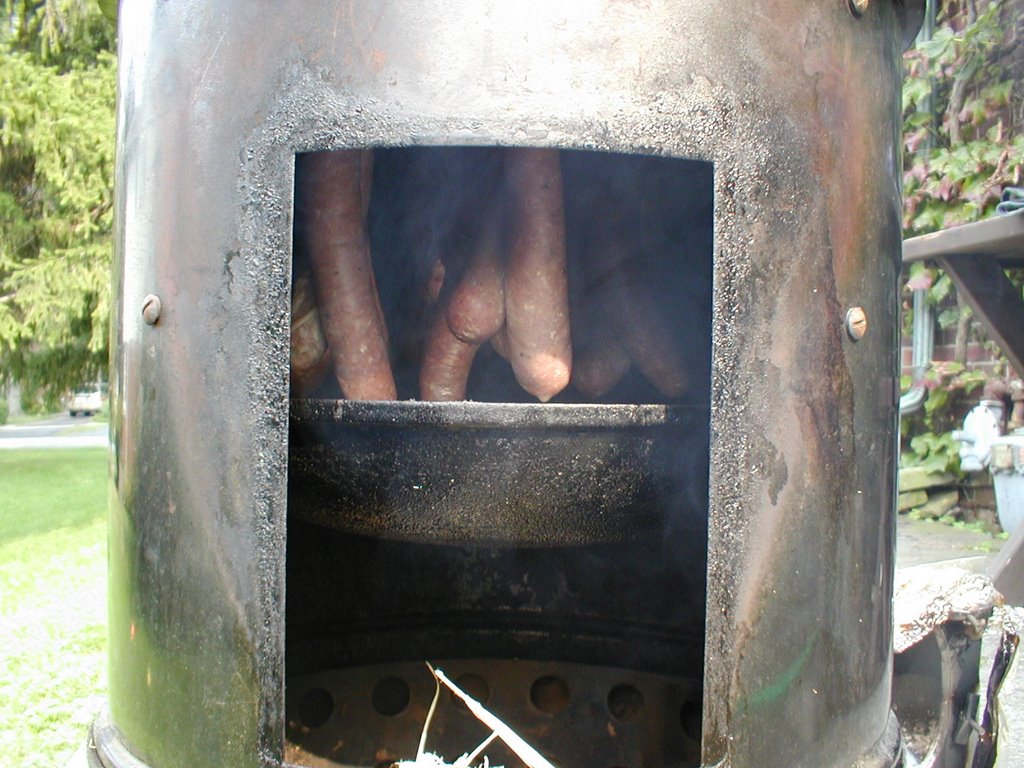
For the fire I started with a little charcoal then used split hickory. Since I kept a small fire, I had to tend to it a lot. I suppose you could use the wood chunks that Weber makes but I would trim off the bark first.
So why cold smoke? For smoke you need fire, fire cooks things, so if you want to put a lot of smoke on something without overcooking it, cool the smoke. One of the concerns in holding meat in the 100F zone is that bacteria can thrive; the meat must be cured.
After the cold smoke, the sausages did not look much different but after the hot smoke..Now that looks like sausage.

special thanks to the boys for providing the risers.
5. The finish
So anyway the thuringer and the summer sausage were among the featured attractions for an office party S put together. The German guy from the Dubai office said he had never had thuringer cured and cooked like this but he thought it was good. The guy from the international sales department wanted to know what made the summer sausage spicy, I wasn't sure..Maybe the combination of pepper and the smoke? I had forgotten that I had put in a secret ingredient.

Secret ingredient.
As I mentioned in the previous post (I know, so long ago you forgot) The ingredients for both sausages are virtually identical except one is beef the other pork. Additionally, The pork thuringer had whole peppercorns while the summer sausage had no pepper at all. The spicy flavor came from ground mustard. In the thuringer I used plain old Coleman's mustard powder, but for the summer sausage, I ground up whole black mustard seeds (see photo). I picked it up at the Spice House. I think the mustard made a made the difference. While S thought both sausages were good, I thought the summer sausage was way better. The thuringer seemed rather one dimensional. The fermento was very interesting, both sausages had that salami "tang."
As for cold smoking, it idefinitely worth the trouble. I recently used the rig to smoke bacon and kielbasa. I'll have to do some research to maybe simply the process. A lot of cold smokers use hickory sawdust to create the smoke, maybe that's next. In the mean time I will try to keep you up to date on the state of the sausage in a more timely manner. As fall brings in the cool weather it is time to work on dry curing salami and maybe some guanciale.
Cheers.
P.S. Update on the Prickly Pear Episode: After a month in the basement we had a syrupy tart purple liquid which no one bothered to mix into margaritas. To drink it straight it was peppery, then floral, then a sweetart pucker followed by a hot breath that went through your throat out your shoulders then tingled down your back. Needless to say the entire liter was drunk in one night (the office party). All that was left was several plastic cocktail cups half full of maserated fruit. I said the fruit was too seedy to be eaten(like giant raspberries with seeds the size of Mini Chiclets) but once you start chasing the prickly pear, I guess you have to find out for yourself.
17 August, 2006
Columbus….Oh. – Chicken Sausage and Peach Sangria Recipe

At least that is what it says on one of my mom's placemats. I believe those lines should be attributed to Gillian Douglas, but a Google search did not turn up much on her, maybe because she's Canadian.
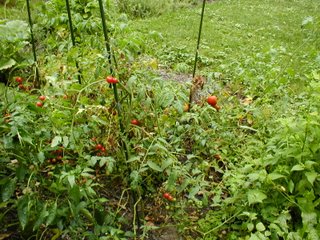
But August is the fairest of months, the sweetest of summer, we start to get some cool nights, the garden is mature, tomatoes and peppers must be picked. It is also my favorite time to visit the family homestead in Columbus.
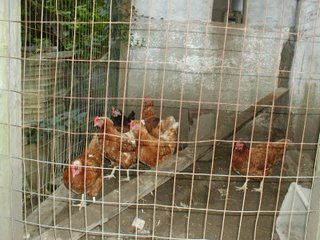 Hello girls.
JL hitched in for a short visit too. She is off to Ethiopia next week and has promised dispatches from the New Flower (Addis Ababa) for our humble blog. She'll be there for a year. To send her off in a proper fashion I figured to make some sausage. JL said she hadn't had a decent chicken sausage and wondered if we were up to the challenge.
We went to Weiland's Market for supplies. Weiland's has been in the Clintonville area forever and it has always been the place to go for meat. About six years ago they vastly expanded when they took over a space that used to be an A&P (Yeah, I remember when it was an A&P, and Volunteers of America was a Buckeye Mart). Now they offer an extensive selection of gourmet stuff, perfect for the summertime party. We picked 3 ½ pounds of chicken thighs, some pork fat (trimmed on the spot and free), a few Ohio peaches and bottle of Piesporter Michelsberg.
Making sausage is relatively easy, but there are some details to follow and I recommend you read about it. Some good books are: Charcuterie: The Craft of Salting, Smoking and Curing, Bruce Aidells' Complete Sausage Book , or Cooking by Hand. You should be able to get any of these books at the library. As for equipment, you need a grinder and a stuffer. Provided you have a Kitchen-Aid Stand Mixer, the easiest and cheapest way to get grinding and stuffing is with a grinder and stuffing attachment. The Charcuterie book offers specific instructions using this equipment.
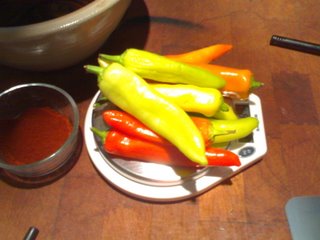
I don't know what kind of peppers these are, but the red ones are kind of hot.
Now for the sausage. We got some mystery peppers out of the garden (I say mystery because we only bought poblanos jalapenos and sweet reds and these look like none of the above), roasted, cored, seeded and chopped them up for the mix. I diced the Chicken and the fat and tossed them with some cornstarch. The cornstarch idea comes from stir-fry; a cornstarch dusted meat retains its water, I dunno it works in the Phad Thai, see if it works here. Then I mixed in the toasted spices, and some garlic and a let it sit for a hour.
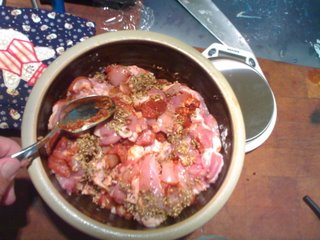
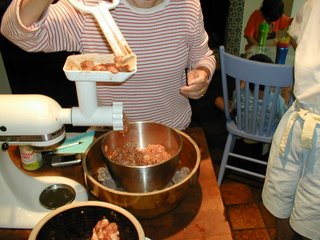
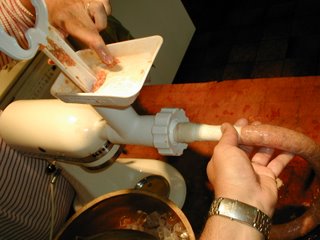
Mom helped with the stuffing.

Time for the grill. As you can see here our little sausages are bursting at the seems. JL asked why we didn't boil them first. I gave her a long winded answer that wasn't entirely accurate but after a little reading here's what I should have said: Boiling (more accurately poaching in a water bath 180-200F, which I did say) is a good way to get a sausage up to temperature. It's gentle and accurate. Cook a sausage to 160F (maybe a little higher for chicken), beyond that cooking just dries it out. However poaching imparts little flavor; Grilling has the best flavor. The problem with grilling is controlling the heat. If a sausage cooks too fast it may burst and get over cooked. Grill over medium heat. Our fire here was a little hot.

Time for dinner. Some tomatoes from the garden chopped up with some fresh mozzarella, corn pudding from grandma, and to drink peach sangria. With peaches in season what could be better.
The sausages turned out very nice. Usually a chicken sausage has dry and flat taste, but I think the added fat and the roasted peppers brought the meat around for a full flavor and plenty of moisture. I don't know if the cornstarch helped with the moisture issue, I'll try it sometime without it. The ingredient list follows.
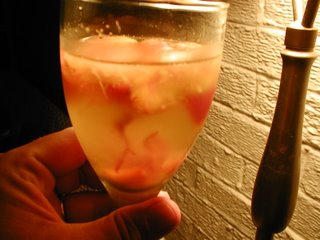
JL adapted the peach sangria recipe from Bon Appetit, August 2003. 1 bottle of white wine, 750 ML of white cranberry Juice, ½ cup peach schnapps, 4 peaches peeled and sliced and 1 lemon sliced.
Italian Chicken Sausage with roasted peppers.
3-1/2 lbs Boneless skinless chicken thighs
¾ lb Pork fat
8 oz (weight before cooking) Mild peppers (Anaheim)
2 Cloves garlic, peeled minced
30 g Kosher flake salt
20 g Paprika
16 g Whole fennel seed, toasted
8 g whole coriander seed, toasted
2 T Cornstarch
175 ml Cider Vinegar
Cheers
27 July, 2006
Prickly Pear
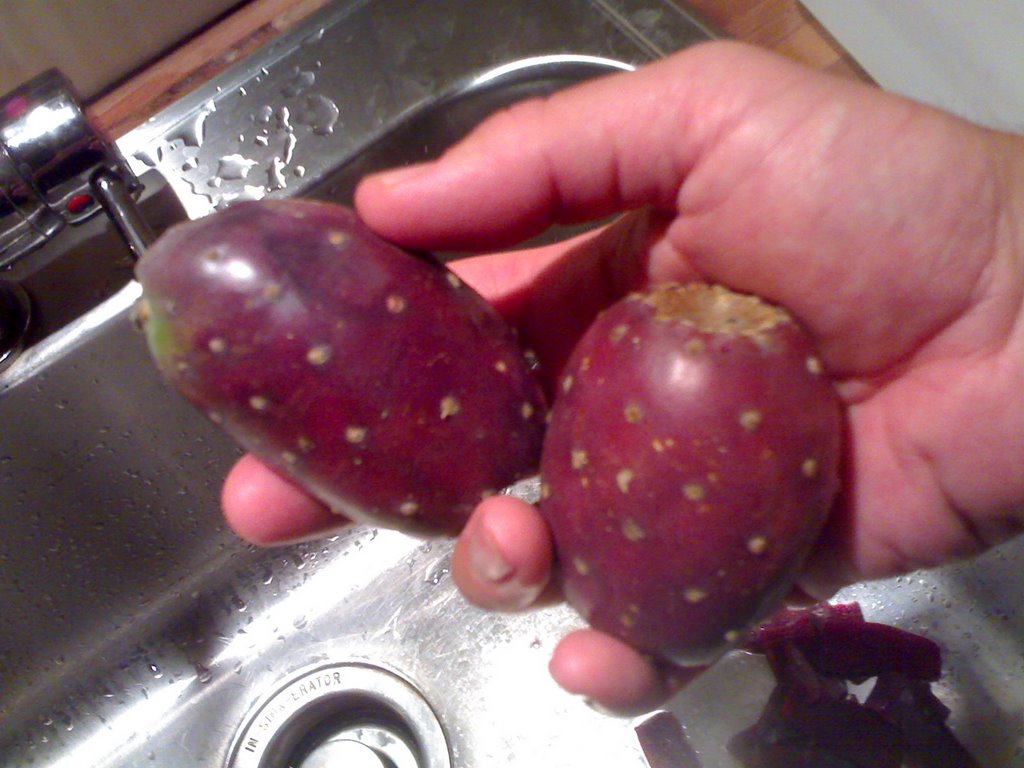
Last week me and the boys were toolin around the Southland, as we so often do, in search of an adventure or some cool park play toys. Rollin down Avenue O, we came across Pete’s Fresh Market. This store is incredible. It is brand new, the size of a Jewel but twice as beautiful. On top of that, it is a Mexican supermarket. The produce was beautiful: I got Plantains, Papaya(cheap), Guava, Parcha, I got 3 pounds of Jalapenos for $1.49 (We will be seeing them in an upcoming episode). I got 12 limes for a dollar. And Mexican spices and dried peppers, forget about it. The meat case was immaculate; I ended up getting my pork shoulder, for the pork tacos, there. But I went in only looking for one thing: Opuntia phaeacantha; the purple prickly pear.
It must be about ten years about now that I came across an article about soaking the fruit in tequila (infused liquors for youse fancy pants). Well I lost the article and an internet search did not turn up anything, so here’s what I did: I carefully peeled (using a vegetable peeler) about a dozen or so fruits, sliced them and poured a liter of white (no Cuervo) tequila over them.
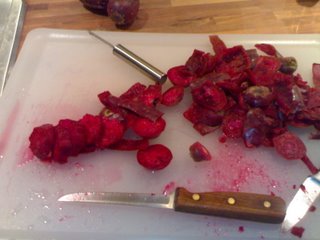
I don’t know how long it should set, but the liquor had taken the purple color overnight. I haven’t tasted it yet either, but what I remember from ten years ago is that the prickly pear adds a tart taste and a floral aroma to the liquid. I'll let it go until I am ready to make some drinks. From there we will make some purple margaritas or maybe just a tiny tumbler with cracked ice and a sugar cube.
S looked for prickly pears (also called tunas) earlier in the year and she was told there is season for the fruit which lasts around July. So go get em. It will be great for that late summer garden party. 
There are two kinds of tunas that you may come across at the store: Purple and white. Don’t get white. They both have green skins but you will notice a reddish hue to the purple ones. When selecting think of selecting an avocado ($.79 each at Pete’s): Not too hard and not too mushy. The fruit itself is very fibrous and has lots of seeds so you may have to strain it, but I think it is gonna be good. Stay tuned.
Cheers.